
Picture a Friday night at a decent neighborhood restaurant. The dining room is full, the kitchen is two tickets behind, the host is seating a walk-in party of six, and the phone — the phone has been ringing for twenty minutes straight. Every one of those calls is a reservation, a takeout order, or a regular asking if the patio is open. Most of them go to voicemail. Most of those people book somewhere else.
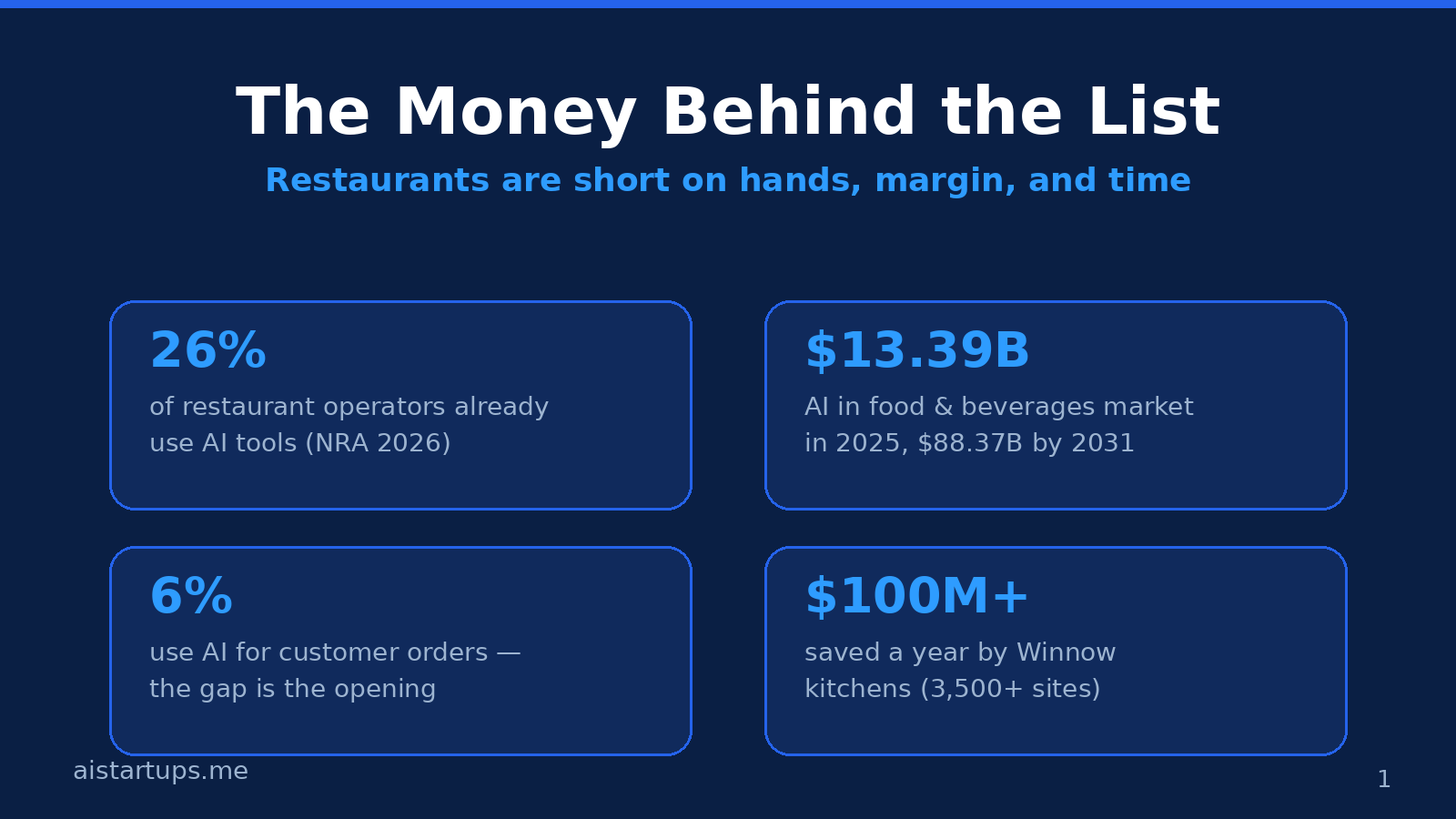
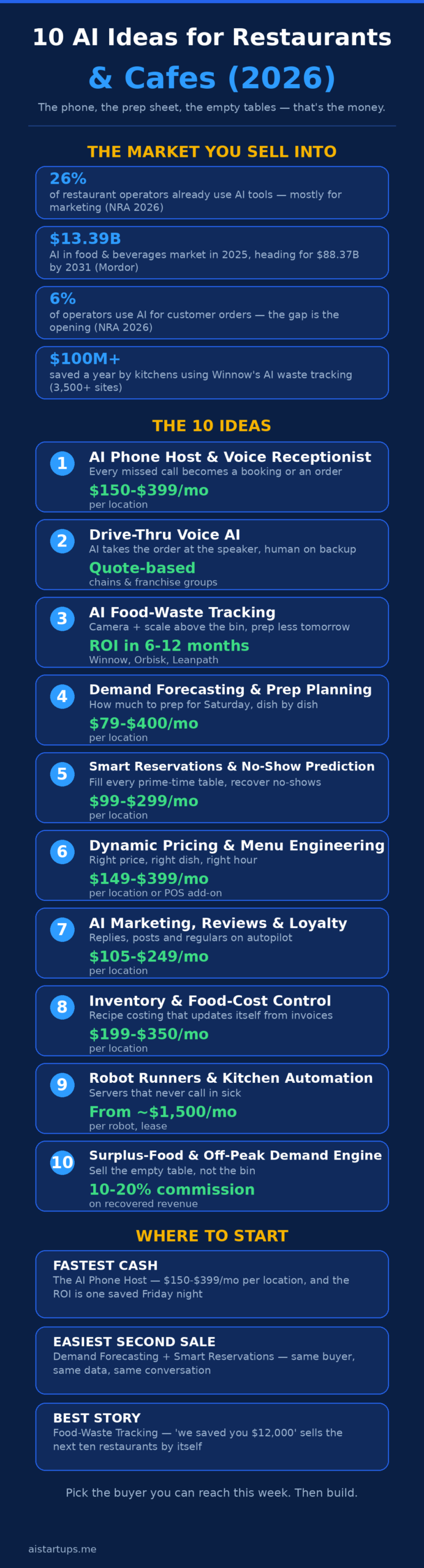
That’s the restaurant industry in one scene: a business that runs on razor-thin margins, chronically short-staffed, and still doing a shocking amount of its work by phone, by memory, and by gut feel. And it’s exactly why this is such a good place to build right now. According to the National Restaurant Association’s State of the Restaurant Industry 2026 report, 26% of operators already use AI tools — mostly for marketing. But only 6% use AI for customer orders. That’s the gap. The boring, operational, money-leaking jobs — answering the phone, prepping the right amount of food, filling the empty tables — are still mostly done by humans under pressure. And the market behind it is enormous: the AI in food and beverages market is valued at $13.39 billion in 2025 and projected to reach $88.37 billion by 2031.
So this list is 10 AI product and service ideas for restaurants and cafes that a solo founder or tiny team could realistically build and sell. Each one gets the same treatment — the pain, the product, who pays, and rough pricing. No venture funding required. One ground rule runs through all of them: sell to the owner’s pain, not to your own excitement about the tech. A restaurant owner doesn’t care about your model architecture. They care about Friday night. Let’s go.
How I scored these ideas
Before the list, a quick note on how I’m judging. Every idea gets two rough scores: startup cost (how much time and money to build a working version) and revenue potential (how big the check is and how often it repeats). Cheap-to-build plus big-money is the sweet spot. But there’s a third factor I care about more in restaurants than in most industries: who the buyer is. A product sold to a restaurant group with ten locations is a completely different business from an app sold to a cafe owner who cancels after the free trial. The B2B ideas on this list will look boring next to the consumer apps. Boring is good. Boring pays rent.
One more thing before we start: every price in this article is a rough estimate, not a quote. Treat them as starting points for your own research, not gospel. The market numbers, though, are real — every stat is linked to its source, and where the sources disagree, I’ve said so instead of picking the biggest number and pretending the others don’t exist. Vendor claims are labeled as vendor claims, because a company saying its own product works is not the same as a customer saying it works.
Idea 1: The AI Phone Host & Voice Receptionist
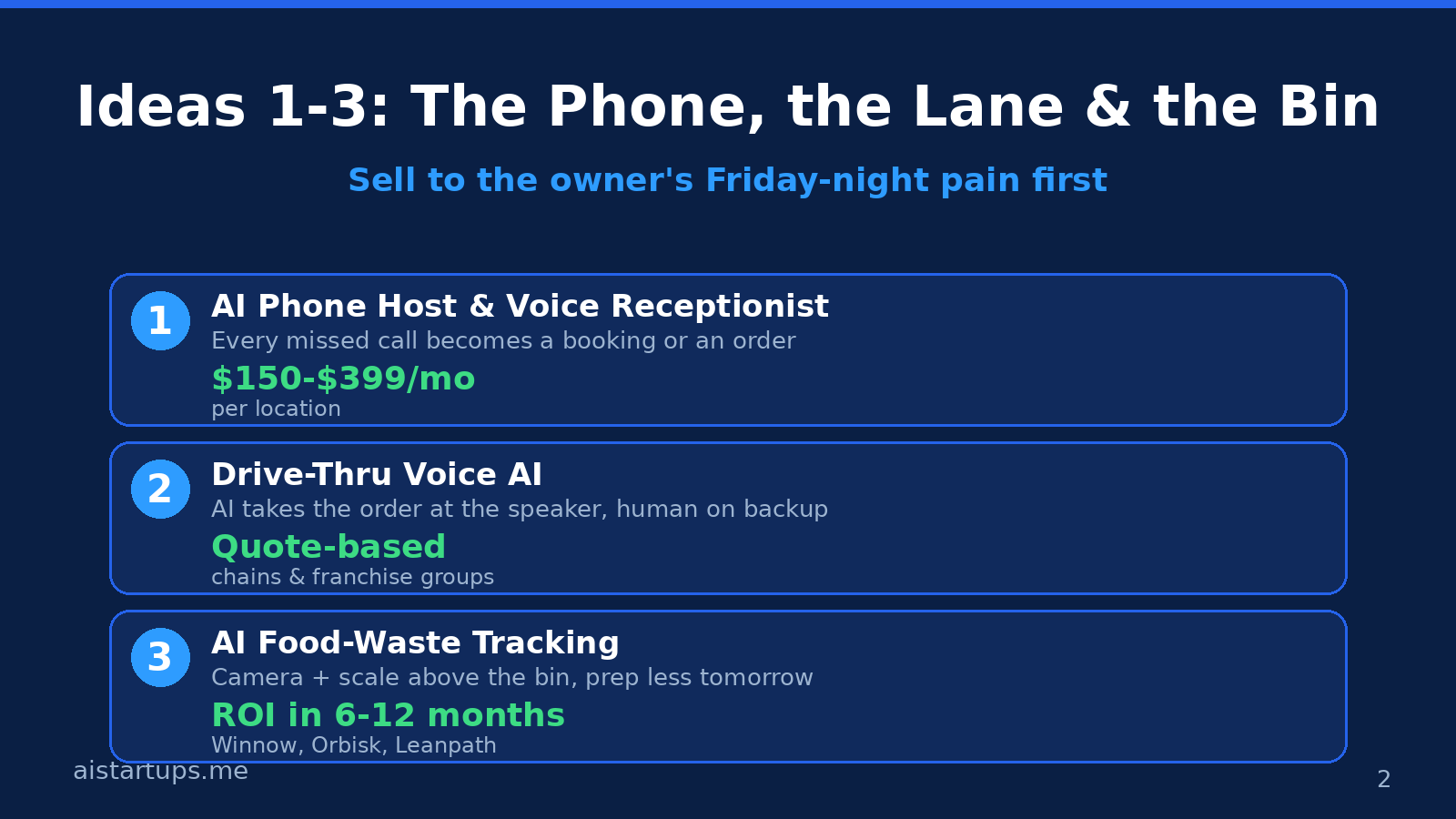
Let’s start with the ringing phone from the intro, because it’s the single most obvious money leak in the industry. A restaurant’s phone rings hardest exactly when nobody can answer it — Friday dinner rush, Saturday brunch, the lunch hour. The host is seating people, the servers are running food, and the phone goes to voicemail. Every missed call is a table that didn’t get booked or a takeout order that went to the place down the street. One operator I read about tested an AI host at a Houston restaurant: it answered 273 real calls in three weeks, and 40 of them became paid orders. That’s not a demo. That’s found money.
The product: an AI voice host that answers every call, every time. It books reservations against real table availability, takes phone orders straight into the POS, answers the same ten questions every caller asks (hours, parking, do you have a gluten-free menu, is the patio open), sends a text confirmation, and hands the tricky calls — the furious regular, the 40-person rehearsal dinner — to a human. The best versions record and summarize every call, so the owner can read in the morning what happened overnight instead of guessing.
Why does this sell so easily? Because the owner can hear the problem in their own restaurant tonight, and the demo takes an hour. You don’t need a slide deck. You call their number during service, let the AI answer, and watch their face. The pricing is public and honest, too: Slang.ai publishes $399 a month per location for its Core plan (reservations, call summaries, integrations with OpenTable, SevenRooms, Yelp, and Fishbowl), $599 for Premium. Cheaper options exist — Maple lists $150 a month for answering and $350 for ordering and payment, Popmenu’s phone add-on starts at $149 a month. Your product doesn’t need to beat Slang on features. It needs to beat them on setup time, on working with the POS the restaurant already has, and on being the vendor who actually picks up the phone when the owner calls.
Who pays: independent restaurants and cafes, $149–$399/mo per location. Or restaurant groups, $1,000–$3,000/mo for a multi-location deal with a shared dashboard. I’d start with independents — one owner, one decision, and they talk to other owners constantly. If you want a sense of how the same admin-automation play works in other local verticals, AI services local businesses actually buy covers the same pattern — but restaurants have a built-in advantage most local niches don’t: the pain happens every single night, so the ROI conversation takes about thirty seconds.
Idea 2: Drive-Thru Voice AI for Quick-Service Restaurants
Now the same problem, but at the drive-thru speaker — and at a scale where the numbers get silly. The big chains have been throwing money at this for years. McDonald’s wound down its IBM drive-thru test in 2024 after viral clips of misheard orders. Wendy’s kept going with FreshAI, built with Google Cloud. And the specialist vendors are now a real market: Presto, Hi Auto, SoundHound, ConverseNow, Omilia, Incept AI. The 2026 vendor comparison is blunt about the state of play — most of these companies sell to chains and franchise groups, none of them prints a price, and each one connects to the lane in its own way.
The product: a voice AI that takes the order at the drive-thru speaker, handles modifiers (“no onions, extra pickles, split the sauce”), suggests a relevant add-on, and drops the order into the POS — with a human supervisor in the loop for the calls the AI isn’t confident about. That last part matters more than the AI itself. Hi Auto, one of the more deployed vendors, reports 93% order completion and 96% accuracy across about 1,000 stores, with a remote supervisor behind the AI. Presto’s own SEC filings told a more honest story: around 70% of its AI-handled orders still needed a human to step in. The honest pitch isn’t “replace your order-takers.” It’s “your order-takers stop repeating the same forty items into a speaker and start fixing the orders that actually need a person.”
Here’s the thing, though — and I want to be straight about this one. For most solo founders, selling drive-thru AI to chains is the wrong first move. The sales cycle is long, the buyer is a franchise operations team, and the deployment needs POS integrations you don’t have yet. The real opening for a small player is the tier below the giants: the regional chain with 20–80 locations, the franchise group that can’t get a meeting with the big vendors, the single-lane independent with a drive-thru doing a few hundred orders a day. Presto raised $10 million in September 2026 and integrated with Toast the same month — the market is consolidating, which means the mid-market is about to get served by someone. It could be you, if you start with one franchisee and one lane and prove it in their numbers, not yours.
Who pays: quick-service franchise groups, quote-based — typically a per-location monthly fee plus a setup charge. The honest version: budget 6–12 months from first conversation to a paid pilot, and don’t build this as your first idea unless you already have a franchisee who’ll take your call. If drive-thru feels too heavy, idea 1 (the phone host) is the same technology with a much shorter sales cycle.
Idea 3: AI Food-Waste Tracking for Commercial Kitchens
Here’s a number that should stop you mid-scroll: the average restaurant throws away somewhere between 4% and 10% of all the food it buys. Not because the chef is careless — because nobody measures it. The bin gets emptied, the prep list gets written from memory, and the same overproduction happens every Tuesday. Winnow, the company that built the category, puts a camera and a scale above the kitchen bin. The system recognizes what’s being thrown away, weighs it, prices it, and tells the chef what to prep less of tomorrow. According to Winnow’s 2025/26 Impact Report, more than 3,500 hotels, restaurants, and other sites using its technology now save over $100 million in food costs every year.
Now — and this matters — that’s the company’s own figure, and the independent evidence is more modest. A Cornell study of about 900 kitchens found 29% less waste three months after adopting the system. That’s still a great result. It just isn’t the “cut waste in half” headline on the sales page. Orbisk, the main challenger, claims around 90% recognition accuracy across 800+ ingredients, up to 70% waste reduction, and an average of €72,000 a year saved per site in a published nine-site cohort. Leanpath, the US benchmark, says its customers save about $7 for every $1 invested. The spread between the company claims and the academic numbers is the whole lesson of this idea: measure honestly, and your customers will trust you more than the vendor with the bigger slide.
The product: you probably aren’t building a better computer-vision bin from scratch — Winnow and Orbisk have a billion food-waste images between them. The opening for a solo founder is the layer around the bin: the small-restaurant version. Winnow and Orbisk sell to hotels and chains with a hardware install and a coaching program. The independent restaurant with one kitchen, the cafe group with six sites, the catering company that preps in a commissary — they can’t justify that install. A lighter product works here: phone-based photo logging at the bin, AI that reads the photo and estimates weight and cost, a daily “prep less of this, more of that” sheet, and a weekly food-cost report the owner actually reads. Sell it as a subscription, not a hardware project.
Who pays: independent restaurants and small groups, $99–$299/mo per location for the light version; hotels and chains pay the full hardware vendors far more. The pitch is simple arithmetic: if a restaurant wastes 8% of a $500,000 food spend, that’s $40,000 a year in the bin. A 30% cut is $12,000 back. Your fee is a rounding error against that — and unlike most ideas on this list, the customer can verify the savings in their own P&L within a quarter.
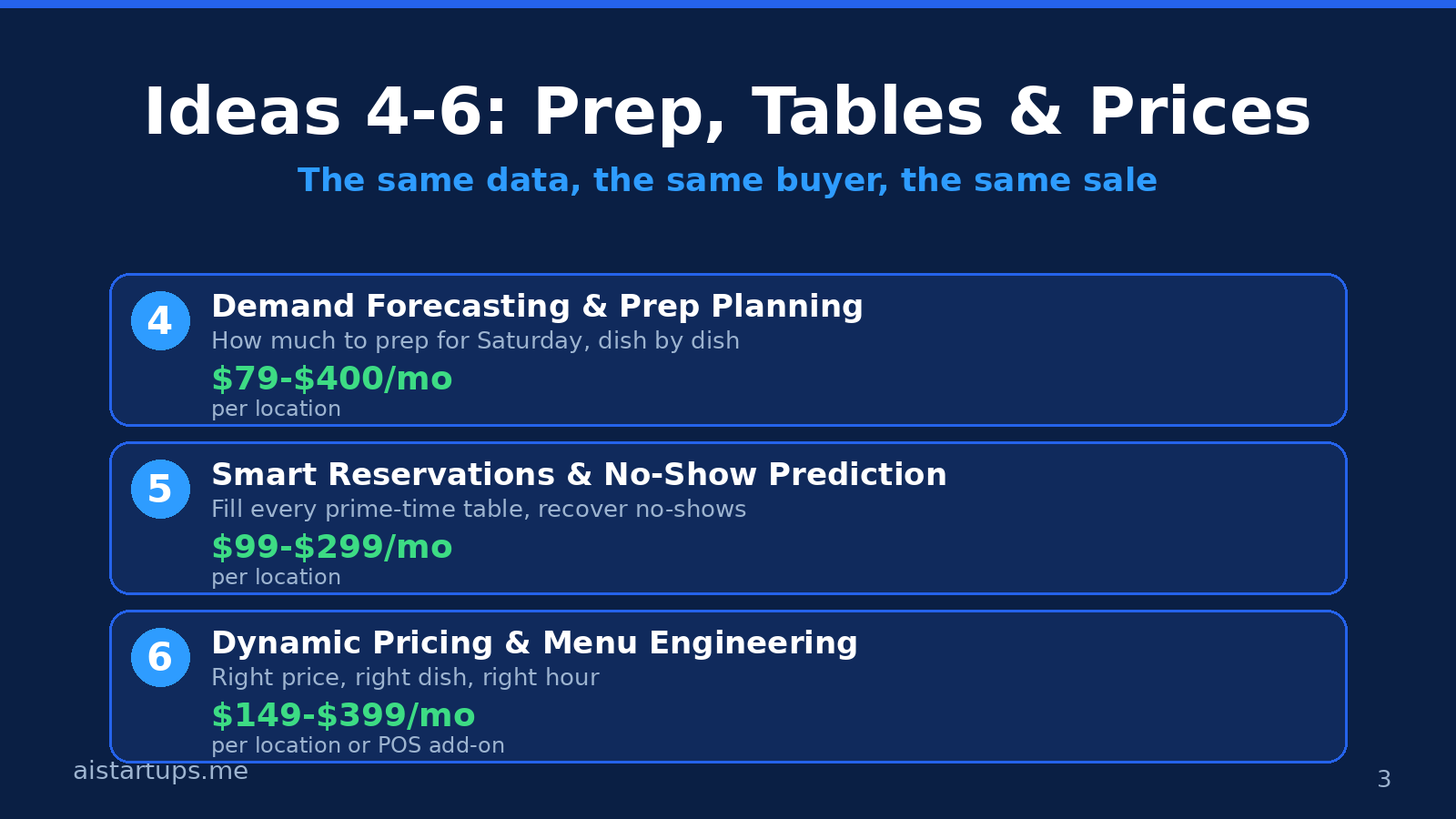
Idea 4: Demand Forecasting & Prep Planning
Every kitchen manager knows the two ways a Saturday can go wrong. Prep too much and you’re throwing food away at close. Prep too little and you’re 86-ing the best-selling dish at 7 PM, which is the moment your regulars decide to try somewhere else next weekend. The prep sheet gets written on Friday from last Saturday’s numbers and a feeling about the weather. That’s the whole system. And it’s a system that burns money in both directions at once.
The product: a forecasting engine that tells the kitchen how much to prep, dish by dish, for each service. It pulls the POS sales history, the reservation book, the weather forecast, local events, holidays, and the catering orders, and it produces a prep sheet — not a dashboard, a sheet, printed or on a tablet at the pass — that says how many portions of each item to make. ClearCOGS does this for restaurants and says its customers cut waste by 20–40% in the first 90 days, at roughly $200–$400 a month per location. Lineup.ai forecasts sales and labor per location from $79 a month (forecasts only) or $149 with scheduling. Tenzo merges POS, labor, inventory, and review data and forecasts demand from weather, events, and history — quote-only, but the concept is the same. The pattern is proven. The price point is reachable. The gap is that most of these tools are built for groups, and the single-location restaurant still plans Saturday on a whiteboard.
Why this is a great second business (after the phone host): the customer is the same person, and the sale is the same conversation. “You already trust me with your phones — want me to stop the Saturday 86-ing too?” The data is already sitting in their POS; you’re just reading it better than they are. And the feedback loop is daily — the chef sees on Monday whether the forecast was right, which means the product either earns its keep in week one or gets cancelled in week two. That’s scary, and it’s also exactly why it’s honest. Build the version that integrates with Toast and Square first, because that’s where the data lives for most independents, and ship the prep sheet as the product — not a dashboard the chef has to learn, but a list they can tape to the wall.
Who pays: restaurants and cafes, $79–$400/mo per location depending on depth. Start at the low end with forecasting only, then add scheduling and ordering as the customer trusts you. One caution: never promise a percentage. Say “here’s what the forecast got right last week” and let the chef’s own numbers do the selling.
Idea 5: Smart Reservations & No-Show Prediction
A no-show at a tasting menu costs hundreds of dollars. A no-show at a regular table on a Friday costs the turn you could have given to the walk-ins waiting at the bar. And yet most restaurants still manage reservations the way they did a decade ago: a book, a phone, and a prayer. The platforms have gotten smarter — SevenRooms now ships AI tools that answer calls and book straight into the reservation system, run a seating algorithm that weighs party size, history, and live demand, and recommend dynamic pricing based on demand patterns. SevenRooms says 64% of diners still call to book, which is why its voice AI exists at all. OpenTable, Resy, and SevenRooms all offer automated reminders, deposits, card holds, and waitlist backfill now. The table is being managed by software. The question is who sells the intelligence layer to the restaurants that can’t afford the enterprise platforms.
The product: a no-show prediction and table-recovery service for independent restaurants. It watches the reservation book and scores each booking for no-show risk — first-time booker, large party, booked a week out, never confirmed, a phone number that doesn’t answer the reminder text. High-risk bookings get an extra confirmation nudge, a deposit request, or a call. When a table does free up, the waitlist gets pinged automatically, in order, with a 15-minute claim window. The pieces are not exotic — automated reminders, two-way SMS, deposits, waitlist alerts — but the restaurants that need them most are the ones running reservations on a shared Google Calendar and a landline. One vendor’s case study claims a 35% reduction in no-shows with AI feedback and reminders; treat that as a vendor number, but the direction is right, and even half of it is real money on a Friday night.
And here’s the twist that makes this idea more interesting in late 2026 than it was a year ago: the reservations are starting to arrive without a human on either end. In October 2026, TechCrunch covered Zest, a restaurant discovery app whose AI concierge books tables over text — it reads a group’s tastes from card transactions, settles the argument in a group chat, and books through OpenTable, Resy, or SevenRooms without anyone opening a browser. The point for a founder isn’t Zest itself. It’s what Zest implies: if your client’s availability isn’t in a system an agent can read and book, your client simply doesn’t exist in that decision. Selling “get your restaurant bookable by the AI concierge” is a pitch that lands very differently in 2026 than “buy my reservation software” did in 2024.
Who pays: independent restaurants and small groups, $99–$299/mo per location for the no-show and waitlist layer; the full reservation platforms charge more and sell through sales teams. I’d sell this one bundled with idea 1 — the phone host already handles the calls, so the reservation layer is a natural upsell, and one vendor owning both means the confirmation text and the booking actually agree with each other.
Idea 6: Dynamic Pricing & Menu Engineering
Your menu has a price. It has had the same price since the last reprint, which was probably six months ago, which was probably when the owner guessed. Meanwhile the cost of chicken moved, the Saturday 7 PM slot is worth twice the Tuesday 3 PM slot, and the dish that sells best also happens to be the one with the worst margin. Nobody in the restaurant knows that last fact, because nobody has ever sat down with the POS data and the recipe costs at the same time. That’s menu engineering, and it’s a job AI is genuinely good at.
The product: a pricing and menu engineer that reads the POS and the recipe costs and tells the owner three things. First, which dishes make money and which ones are vanity — the “stars, puzzles, plowhorses, and dogs” analysis that consultants charge thousands for, done weekly and automatically. Second, what to charge: small, tested price moves on the dishes where demand is inelastic, and off-peak pricing that fills dead hours — the Tuesday 3 PM problem from idea 5, solved with a price instead of a prayer. Third, what to promote: the high-margin dish that sells well when the server mentions it, surfaced in the pre-shift briefing instead of buried in a report nobody opens. SevenRooms already bakes dynamic pricing recommendations into its platform; Juicer and Sunday sell similar tools to chains. The independent restaurant is still pricing by feel.
Real talk: this is the idea on the list most likely to get you thrown out of a restaurant if you pitch it wrong. Owners hear “dynamic pricing” and think “surge pricing my regulars.” So don’t pitch it that way. Pitch it as menu engineering — “I’ll show you which dishes are losing you money” — and let the off-peak pricing come later, framed as a happy-hour special the owner already understands. The technology is the easy part. The trust is the product. Start with one report, delivered free, built from the owner’s own POS export: “here are your five best and five worst dishes by margin.” If that report doesn’t make them want the next one, the idea isn’t for them, and you’ve learned it in a week instead of a quarter.
Who pays: restaurants and small groups, typically bundled into a POS or reservation platform add-on, or $149–$399/mo as a standalone. Honestly, this one works best as an upsell to ideas 4 and 5 — the same data, the same buyer, the same conversation. If you want a sense of how to think about the pricing of the product itself, how to price an AI SaaS product walks through the tiers, trials, and token math that apply here too.
“The restaurants that win with AI aren’t the ones with the most AI. They’re the ones that picked three jobs — the phone, the prep sheet, and the empty tables — and actually shipped them.”
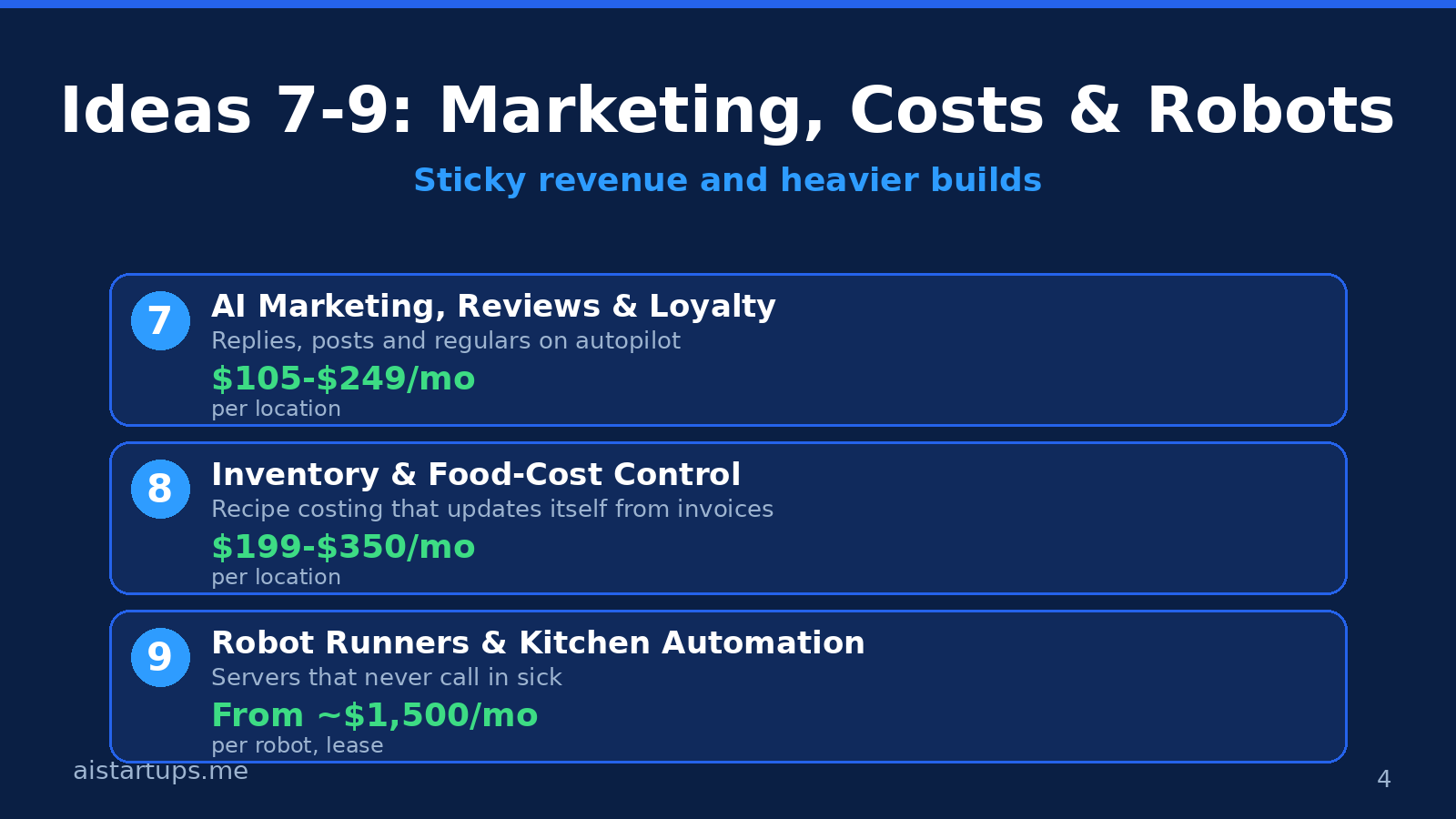
Idea 7: AI Marketing, Reviews & Loyalty
Here’s a stat from the NRA’s 2026 report that should shape your whole sales approach: marketing is the most common AI use case in restaurants — 19% of full-service operators and 15% of limited-service operators already use AI for it. That’s not a coincidence. Marketing is where the owner feels the pain every day (empty Tuesday, a bad review sitting unanswered for a week, an Instagram account that hasn’t posted since March) and where AI is least likely to break anything important. Nobody’s dinner gets ruined by a bad caption. But a bad review left unanswered? That costs real tables.
The product: a marketing autopilot for one restaurant. It drafts the week’s social posts from the actual menu and the actual events (not generic food photos), replies to reviews in the owner’s voice — the owner approves before anything goes out, always — runs the loyalty program (regulars get recognized, lapsed regulars get a nudge, birthdays get a dessert), and writes the email that goes out on Thursday to fill Friday. Popmenu sells this bundle from $149 a month; Bloom Intelligence does guest-data marketing from around $105 a month per location. Toast’s own 2025 survey of 712 decision-makers found 86% of operators are comfortable using AI, with marketing automation the top use case at 28%. The demand is proven. The gap is the same as everywhere else on this list: the tools are built for groups, and the independent cafe with 40 seats is doing it all by hand at 11 PM.
The angle that makes this one winnable for a solo founder: be the human in the loop. The generic tools write generic posts. You — or your small team — set the voice once, approve the queue weekly, and the AI does the volume. The owner gets a feed that sounds like them, reviews answered within hours, and a loyalty list that actually grows. And the retention story is strong: once the review replies and the regulars’ data live in your system, switching costs are real. That’s the kind of boring, sticky revenue that makes a small software business work.
Who pays: independent restaurants and cafes, $105–$249/mo per location. The cafe angle is worth calling out specifically: cafes live on regulars and mornings, so a loyalty and review product that knows who orders the flat white every day at 7:40 AM is selling into a relationship the owner already has — you’re just giving it a memory.
Idea 8: Inventory & Food-Cost Control
Food cost is the number that decides whether a restaurant lives or dies, and it’s also the number most owners understand the least. The recipe says a dish costs $4.20 to make. The supplier raised chicken 12% last month. The portion sizes drifted because the new line cook has a heavy hand. Nobody updated the recipe card. So the owner thinks they’re making 68% margin and they’re actually making 61%, and across a thousand covers a week, that’s the difference between a good month and a bad one. The tools exist — MarketMan publishes $199 a month for Starter and $249 for Growth, with AI recipe creation, live recipe costing, and automatic COGS; MarginEdge charges $350 a month per location for invoice processing, a custom sales forecast, and a built-in assistant — but the independent restaurant is still counting cases of lettuce at 11 PM and wondering why food cost spiked 3% last month.
The product: an inventory copilot that starts from the invoices, not from a count sheet. It scans supplier invoices with AI, flags price changes the owner missed (“chicken is up 12% — your three chicken dishes just lost margin”), updates recipe costs automatically, and suggests the order — what to buy, from whom, and how much — based on the forecast from idea 4. The invoice scan is the wedge: it’s a job nobody likes, it takes an hour a week, and the AI does it in minutes. Once the invoices are in the system, the recipe costing and the ordering suggestions follow naturally, and the owner starts checking the food-cost number the way they check the bank balance.
Why I like this one for a solo founder: the buyer is the same owner as ideas 1, 4, and 5, and the value is provable in the first month. “Your chicken went up 12% and nobody told you” is a sentence that sells itself. The hard part is the integrations — supplier invoice formats are a mess, and the POS and accounting connections take real work. So start narrow: one POS (Toast or Square), one supplier format (the big broadliners), and one city. The restaurant that saves $400 a month on food cost will renew a $249 subscription forever. The one that doesn’t will cancel in month two, and you’ll know exactly why.
Who pays: restaurants and small groups, $199–$350/mo per location. This is the most “real software” idea on the list — the build is heavier than the phone host, but the churn is lower, because once the invoices and recipes live in your system, leaving means going back to counting lettuce at 11 PM.
Idea 9: Robot Runners & Kitchen Automation
Walk into a busy dining room at 8 PM and watch what the servers are actually doing. A surprising share of their shift is walking: kitchen to table, table to kitchen, back again with empty plates. Bear Robotics built a business on that observation. Its Servi robots run food and bus tables, and the company says it has deployed more than 10,000 units globally. The biggest deployment is Japan’s Skylark Group — over 2,100 Gusto restaurants running more than 3,000 robots. In the US, Denny’s and Chili’s locations run them too. The newer Servi Plus carries up to 16 entrees or 88 pounds at once, and the compact Servi Q fits an 18-inch aisle. LG Electronics moved to take a controlling stake in Bear in 2025, which tells you how seriously the hardware world takes this. The lease model runs around $1,500 a month per robot, per industry reporting. Meanwhile in the kitchen, Miso Robotics’ Flippy 2 works the fry station — loading baskets, watching cook times, dispensing finished food — and White Castle runs it in more than 100 locations.
Now the honest part, because this is the idea on the list where the hype runs furthest ahead of the reality. Fewer than 2% of US quick-service locations have any back-of-house robotics at all. Full kitchen automation doesn’t exist yet — every deployed system still needs human supervision, intervention, and backup. And the economics only work at volume: a robot that costs $1,500 a month has to replace more than $1,500 of labor, or serve meaningfully more tables, or it doesn’t pay. The operators who report 30–50% more tables served per shift are the ones with the right floor plan, the right menu, and the right volume. A 30-seat cafe with a narrow dining room is not that restaurant.
So where’s the opening for a founder? Not in building the robot — Bear, Keenon, Pudu, and Miso have that covered, with hundreds of millions in funding between them. The opening is in the layer around the robot: the deployment service. The integration that connects the robot fleet to the POS and the kitchen display. The route-planning that maps a specific dining room so the robot doesn’t get stuck behind the same pillar every night. The staff training that teaches a team to work with a robot instead of around it. The small restaurant group that wants one Servi but has no idea how to install it, insure it, or explain it to their servers — they need a person, not a brochure. Be that person, sell the service, and take a margin on the hardware lease. It’s a services business with a hardware tail, which is a much better business for a solo founder than a hardware business with a services tail.
Who pays: restaurant groups, roughly $1,500/mo per robot on lease plus a setup and integration fee you charge for the deployment. Or the robot vendor pays you, as a deployment partner. This is the most capital-heavy, slowest idea on the list — do it third or fourth, not first, and only if you already have restaurant relationships from ideas 1 or 8.
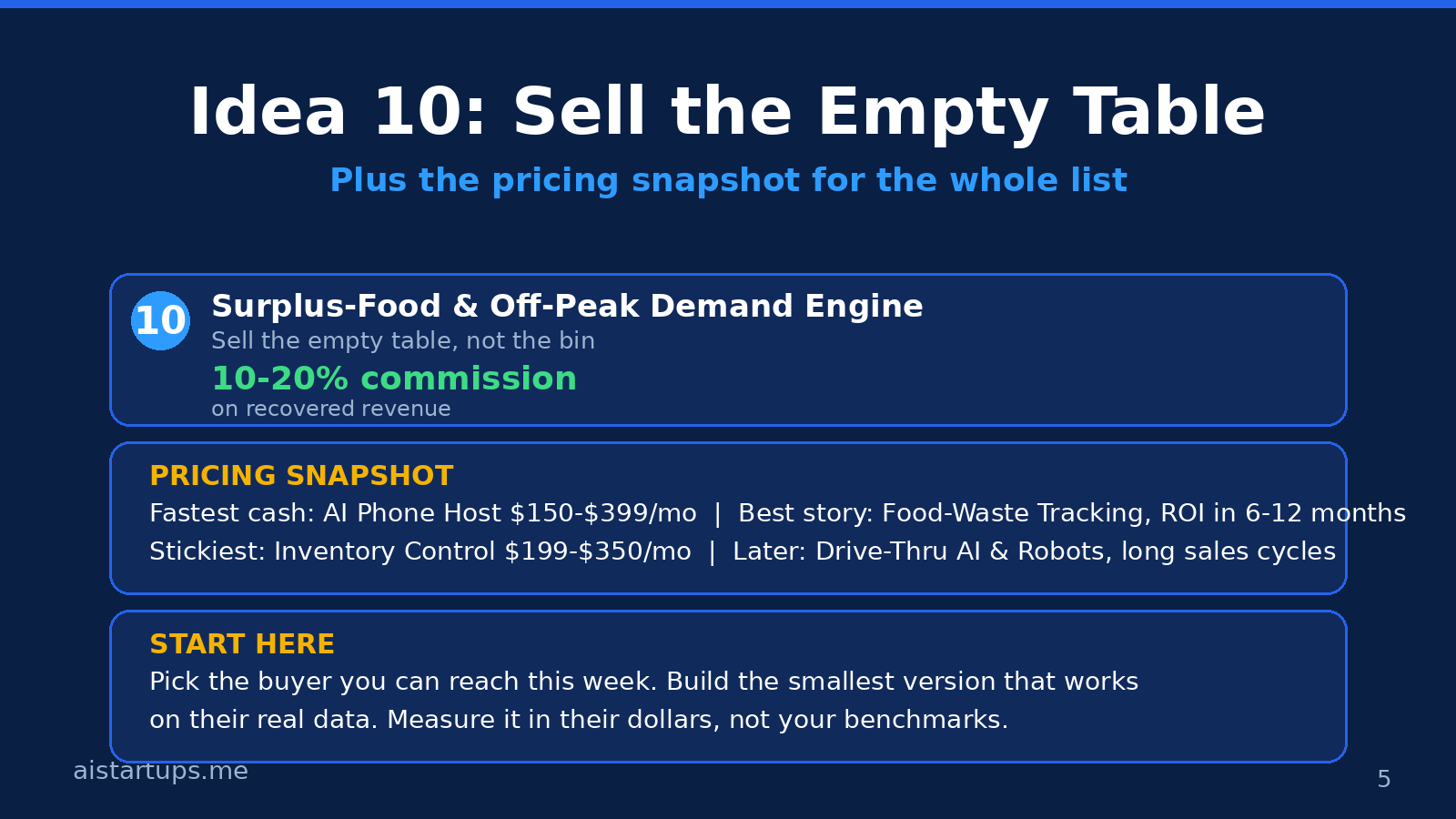
Idea 10: The Surplus-Food & Off-Peak Demand Engine
Last idea, and it’s the one that ties the list together. A restaurant has two kinds of waste: food in the bin (idea 3) and empty tables (idea 5). The surplus-food apps proved the first half — sell today’s leftover pastries, the extra portions, the bread that won’t keep, at a discount before close instead of throwing it away. Customers love it, the restaurant recovers money that was already spent, and the food doesn’t go in the bin. The same logic applies to the tables: the Tuesday 3 PM slot is a perishable product. At 3:05 PM it’s worthless. At 2:30 PM it’s worth a discounted set lunch, a coffee-and-cake deal, or a loyalty offer to the regulars who live nearby.
The product: an off-peak demand engine for one restaurant or one small group. It watches the reservation book and the forecast, spots the dead slots 48 hours out, and fills them — a push to the loyalty list, a limited offer on the surplus-food apps, a dynamic happy-hour price, a “bring a friend, second coffee free” nudge to the regulars who haven’t been in for two weeks. The cafe version is the same shape: the 2–4 PM slump gets a pastry-and-coffee bundle pushed to the loyalty list, and the morning rush gets a pre-order link so the regulars skip the queue. The technology is not the hard part — it’s the same forecasting, messaging, and pricing from ideas 4, 6, and 7, pointed at a different problem. The hard part is the owner’s instinct to discount nothing, ever, because discounting feels like admitting defeat. Your job is to reframe it: the table is already empty. The pastry is already baked. The money is already spent. Selling it for something beats selling it for nothing, every single time.
This is also the idea with the nicest story for a founder’s first customer. Pick one cafe or one restaurant, run it for a month, and measure the recovered revenue in plain dollars. “We filled 14 tables that would have sat empty and sold $620 of food that would have been thrown away” is a case study you can take to the next ten restaurants in the same street. And the model is honest: a small commission on recovered revenue, or a flat monthly fee, and the customer only keeps paying while the numbers keep showing up. That’s the kind of deal a skeptical owner says yes to.
Who pays: restaurants and cafes, commission on recovered revenue (typically 10–20%) or $99–$199/mo flat. The pet-care version of this same “sell the gap” playbook works the same way — 8 AI ideas for pet care businesses covers the booking-and-waitlist version of it — and the fitness version, 9 AI ideas for the fitness & wellness industry, covers the same retention math in gyms and studios. Empty capacity is empty capacity, whatever the industry.
Which idea should you build first?
Real talk: the right first idea depends on who you can reach this week, not which idea is cleverest. Here’s how I’d rank them for a solo founder starting from zero:
- Fastest cash: the AI Phone Host (idea 1). One demo, one owner, one decision. The pain is audible on every Friday night, and the product pays for itself the first week it answers calls the staff couldn’t.
- Best second sale: Demand Forecasting (idea 4) and Smart Reservations (idea 5). Same buyer, same data, same conversation — and they stack into a monthly fee that grows instead of a single product that stalls.
- Best margins: Inventory & Food-Cost Control (idea 8). Heavier build, but the churn is the lowest on the list, because leaving means going back to manual counts.
- Best story: Food-Waste Tracking (idea 3). “We saved you $12,000” is a case study that sells the next ten restaurants by itself.
- Do it later: Drive-Thru Voice AI (idea 2) and Robot Runners (idea 9). Real businesses, wrong first moves — long sales cycles, heavy integrations, and buyers who want references you don’t have yet.
And one practical note if you sell the idea but don’t want to be the one building the website, the booking flow, and the AI integration: partner with a studio instead of hiring. A web development studio like AISquadX can build the customer-facing side — the site, the ordering flow, the AI wired into the tools the restaurant already uses — while you own the relationship and the monthly fee. That’s a real model: you sell, they build, the restaurant pays both of you. Don’t try to be the dev shop, the sales rep, and the support desk all at once in month one. You’ll be bad at all three.
The honest risks (read this before you build)
Three things that will go wrong if you ignore them. First, accuracy. A phone host that books the wrong table or a drive-thru AI that mishears an order doesn’t just fail — it embarrasses the restaurant in front of its customers. Ship with a human in the loop, a confidence threshold, and a graceful handoff, and say so in your pitch. The vendors that hide their intervention rates are the ones that lose the renewal. Second, the menu problem. Independent restaurants have daily specials, build-your-own combos, and dish names the AI has never seen. A voice model trained on a 40-item chain menu will struggle with a 90-item independent menu that changes weekly. Test on the real menu, not the demo menu. Third, the owner problem. The person who buys your product is often the person who has run the restaurant the same way for twenty years. They don’t want a dashboard. They want the phone answered and the tables filled. Sell the outcome, in their words, and let the AI stay invisible.
Frequently asked questions
How much does it cost to build an AI product for restaurants?
A light version — a phone host or a forecasting tool built on an existing voice or language model, integrated with one POS — is realistically a few weeks of focused work and a few hundred dollars a month in API costs. The expensive parts are the integrations and the testing on real menus, not the model. Don’t build your own voice model or your own computer-vision bin. Rent them.
Do restaurants actually buy AI, or is this all hype?
They buy it, but they buy boring AI, not flashy AI. The NRA’s 2026 report puts adoption at 26% of operators, with marketing the top use case — and Toast’s 2025 survey found 86% of operators are comfortable using AI. The products that sell are the ones that answer the phone, fill the tables, and cut the waste. The products that stall are the ones that need the owner to change how they run the kitchen.
Which restaurant AI idea makes money fastest?
The AI phone host, by a distance. The demo takes an hour, the buyer is one owner, and the ROI is visible in the first week — every call it answers is a booking or an order that would have gone to voicemail. Food-waste tracking is the best case-study business, but it takes a quarter to prove the savings. The phone host proves itself on night one.
Do I need restaurant experience to sell to restaurants?
It helps enormously, but it’s not a hard requirement. What you need is one restaurant that will let you test on their real Friday night, and the humility to listen to the owner more than you talk. The founders who fail in this space are the ones who build for a hypothetical restaurant. The ones who win build for the one on the corner that agreed to try it.
Should I sell to independent restaurants or chains?
Independents first, always. One owner, one decision, one demo, and they talk to other owners. Chains mean procurement, pilots, security reviews, and a 6–12 month sales cycle — and the big vendors already own those relationships. Once you have ten independents paying you every month, the franchise groups will take your call. Not before.
The Bottom Line
Here’s what it comes down to. Restaurants are not short of problems — they’re short of hands, short of margin, and short of time. The phone rings during the rush. The food gets over-prepped on Saturday and 86-ed by 7 PM. The tables sit empty on Tuesday and the pastries go in the bin at close. Every one of those is a job AI can already do, and the owners already know it: a quarter of them use AI somewhere, and the ones who don’t are mostly waiting for someone to show up with a product that works on their actual menu, in their actual restaurant, on their actual Friday night.
That’s the job. Not the cleverest model, not the flashiest demo — the product that answers the phone, fills the table, and saves the food. Pick the idea whose buyer you can reach this week. Build the smallest version that works on their real data. And measure it in their dollars, not your benchmarks. The restaurant industry doesn’t reward the best technology. It rewards the vendor who shows up, listens, and makes Friday night easier. Be that vendor.