


Here’s a painful truth about early-stage startups: the CRM decision gets made twice. Once when you pick it, and once when you realize what it actually costs — usually around month four, when the renewal email lands and your “cheap” CRM turns out to have been a teaser rate.
I’ve watched this happen to enough founders that I decided to do the homework properly. I pulled the current pricing pages for the eight AI-powered CRMs that matter most for early-stage startups in October 2026 — the mix of established platforms and AI-native upstarts — and compared what you actually pay, what the AI actually does, and who each tool is honestly for. No vendor rankings-for-hire, no “request a demo” energy. Just the numbers and my take.
One thing that jumped out: almost every CRM now ships an AI agent, and most of them bill it separately from the seat. That’s the hidden second meter in 2026 CRM pricing. I’ll flag exactly where it shows up for each tool, because that’s the number that will surprise you.
How I Picked These 8
A quick word on the shortlist, because “best CRM” lists usually mean “whoever paid the affiliate commission.” My filter was simple: the tool has to make sense for a team of 1–10 people with a real pipeline and a tight budget, and it has to have genuine AI features — not a chatbot bolted onto a 2014 database.
That gave me four established platforms (HubSpot, Pipedrive, Close, Freshsales) and four AI-native ones (Attio, Folk, Clay, Apollo.io). Some are full CRMs. Two of them — Clay and Apollo — are really data-and-outreach platforms that founders increasingly use as their CRM layer, so they’re in, with honest labeling about what they are.
Every price below was checked against the vendor’s own pricing page in October 2026, and I’m showing annual-billing rates (the way most startups actually buy) with monthly rates where they matter. If a price looks different when you check, the vendor moved it — they all do, constantly.
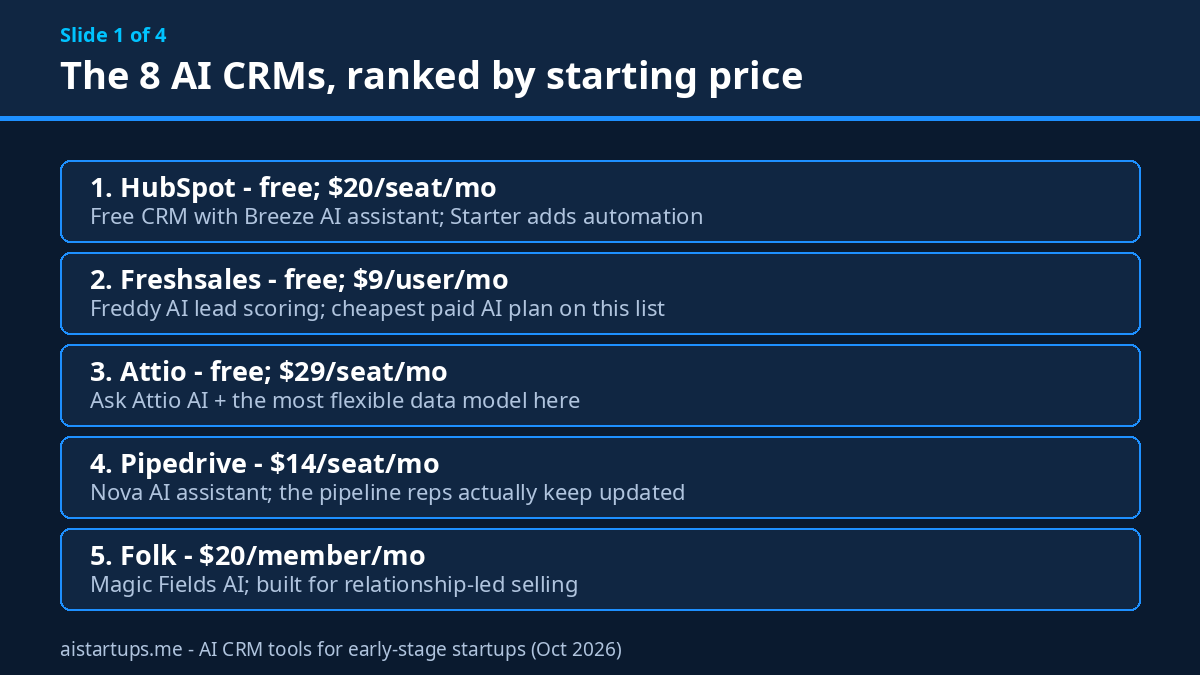
1. HubSpot — The Free Start That Grows With You
HubSpot is the default answer for a reason: the free CRM is genuinely good. You get contact and deal management, pipeline views, email tracking, and live chat at $0, and HubSpot’s own startup guide confirms the free tier is where they want early teams to begin. For a solo founder or a two-person team, you can run on free for months.
The AI story is Breeze — an AI assistant baked into the CRM plus a growing set of AI agents that work across sales, marketing, and service. It’s the broadest AI surface on this list, because HubSpot isn’t just a CRM anymore; it’s a customer platform, and the AI reaches across all of it.
Price: Free ($0). Starter Customer Platform from $20/seat/month on annual billing — and there’s a catch worth knowing: HubSpot currently runs a new-customer offer that drops Starter to $7/seat/month on annual billing (or $10 month-to-month) against a $20 base price. That offer expires, so budget the renewal, not the signup. Professional jumps to $90/seat/month. One more meter to watch: AI usage runs on HubSpot credits, which are bundled in limited amounts and topped up separately. If your team leans hard on the AI features, that credit line becomes part of your bill. (HubSpot’s own startup CRM guide lays out the free-vs-paid line.)
Best for: Teams that want one platform for marketing, sales, and support — and founders who want to start free today with zero migration risk later. If you’re already doing content and email marketing, our lean AI startup marketing playbook pairs well with HubSpot’s free tier.
Watch out: The jump from Starter to Professional is where the price pain lives, and features like workflow automation and custom reporting sit behind it. HubSpot is also the easiest CRM on this list to accidentally overbuy — audit your seats quarterly.
2. Attio — The Flexible One Tech Startups Love
Attio is the CRM for teams who looked at traditional CRMs and thought: why can’t this work like Notion? Instead of a fixed contacts-and-accounts model, you define your own objects, attributes, and relationships. Selling through partners? Tracking investors alongside customers? Running a product-led motion with workspaces? Attio lets you model it instead of bending your process around the tool.
The AI angle: “Ask Attio” is a natural-language layer over your data, and Attio runs AI and workflow automation on a credit system that’s included on every plan — including the free one. Attio also ships AI agents with an MCP server on every tier, which is rarer than it sounds: as one recent CRM comparison put it, most vendors bill the agent separately from the seat, while Attio puts it inside the plan.
Price: Free for up to 3 seats (50,000 records — a real, usable CRM, not a demo). Plus is $29/seat/month on annual billing ($36 month-to-month); Pro is $69/seat/month annual ($86 monthly); Enterprise is custom. Attio’s pricing page is refreshingly readable — annual billing saves about 20%.
Best for: Data-driven startups, PLG companies, and any team whose world doesn’t fit the standard pipeline. If your CRM needs to track things that aren’t deals, start here.
Watch out: Flexibility is a double-edged sword — someone has to design the data model, and a badly designed Attio workspace is worse than a boring one. Integration depth also lags the giants; connecting Attio to databases and ERPs at scale usually needs a sync tool.
3. Pipedrive — The Pipeline Reps Actually Open
Pipedrive has one superpower: salespeople use it. The visual drag-and-drop pipeline is so straightforward that adoption — the thing that kills most CRM rollouts — mostly takes care of itself. For a founder hiring their first reps, “the team will actually log their deals” is worth real money.
On AI, Pipedrive ships Nova, an AI sales assistant that helps with follow-up timing and deal insights, plus AI email tools on the higher tiers. It’s practical AI rather than flashy AI: the kind that reminds you a deal has gone quiet instead of writing you poetry about it.
Price: Four tiers on annual billing — Lite $14, Growth $39, Premium $59, Ultimate $79 per seat/month (monthly billing runs $24/$49/$79/$99). There’s no free plan, just a 14-day trial. Here’s the honest catch: Lite has no email sync and no automation, so the real entry price for a working sales team is Growth at $39. And watch the add-ons — LeadBooster and Smart Docs are $32.50/month each below Premium, Web Visitors is $41/month, and Campaigns starts around $13.33/month. A Growth seat with two add-ons can cost more than a Premium seat that bundles them. (Verified against Pipedrive’s live pricing page in October 2026.)
Best for: Sales-led teams that need a clear, repeatable pipeline and will only use a CRM if it stays simple. If your reps live in the pipeline view, this is your tool.
Watch out: Pipedrive renamed all its plans in late 2025 (Essential became Lite, Advanced became Growth, Professional became Premium, Enterprise became Ultimate), so older reviews quote plan names that no longer exist. And there’s no real marketing suite — if you need one, you’ll bolt it on.
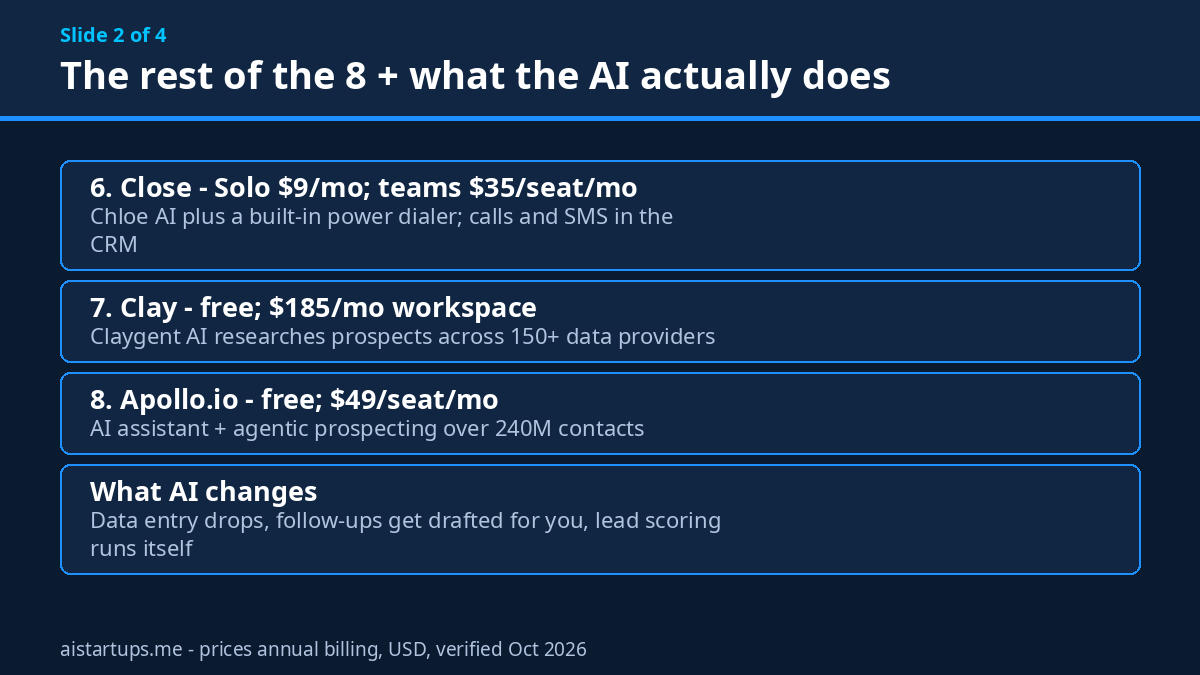
4. Close — Built for Teams That Live on the Phone
Close is the odd one out in the best way: it’s a CRM with a phone system inside it. Calling, SMS, and email live in one interface, with a power dialer that genuinely saves hours a week for phone-heavy reps. If your sales motion is 40 calls a day, nothing else on this list is even playing the same sport.
The AI piece is Chloe, Close’s AI assistant, plus AI credits bundled per plan (500 on Solo, 1,000 on Essentials, 1,500 on Growth, 2,000 on Scale). Conversation intelligence and call coaching show up on the higher tiers.
Price: Solo $9/user/month on annual billing ($19 month-to-month — one user only, 10,000 leads, no workflows). Essentials $35 annual ($49 monthly). Growth $99 annual ($109 monthly). Scale $139 annual ($149 monthly). No free plan; 14-day trial, no credit card. The number that matters beyond the seat: calling minutes and SMS are billed on top of the subscription, so budget a usage envelope, not just the per-seat math. (Verified against Close’s live pricing page in October 2026.)
Best for: Inside-sales teams and founders doing high-volume outbound calling. The built-in calling replaces a separate phone tool, which can make the per-seat price cheaper than it looks once you cancel the other subscription.
Watch out: If your team doesn’t live on calls, Close is overpriced for what you’d use — a $15/month CRM would do. And the jump from Essentials ($35) to Growth ($99) is steep; that’s where the power dialer and automation live.
5. Folk — The Relationship CRM
Folk reimagines the CRM as a lightweight workspace for people who sell through relationships: founders working their network, agencies managing partnerships, investors tracking founders. It centralizes contacts from LinkedIn, Gmail, and X, then layers on AI to keep the whole thing organized.
The AI features are genuinely useful for this motion: Magic Fields that pull structured data (contract value, decision-makers, next steps) out of your emails and calls, automatic contact deduplication, smart follow-up reminders, and one-click enrichment. It feels less like database software and more like a really organized colleague.
Price: Standard $20/member/month on annual billing ($25 month-to-month); Premium $40 annual ($50 monthly); Custom from $80 annual ($100 monthly). No free plan — a 14-day trial with Premium features, no credit card. The gap that matters: deals, sequences, the API, and Zapier all start on Premium, so most sales teams need the $40 tier, not the $20 one. Folk’s own pricing page confirms the trial terms.
Best for: Relationship-driven selling — warm outreach, partnerships, fundraising, agencies. Teams of 5–50 that find Salesforce-style CRMs oppressive.
Watch out: No built-in calling or SMS, so phone-heavy teams will miss it. And if your account lapses after the trial without upgrading, Folk blocks access (your data isn’t deleted immediately, but don’t test this with real pipeline in it).
6. Clay — The Enrichment Engine
Clay isn’t really a CRM — it’s the AI-powered data platform that sits in front of your CRM and makes your lists terrifyingly good. You build tables where each column calls a data provider, an AI model, or an API; its waterfall feature chains 150+ providers in the order you set, stopping at the first verified hit. Then Claygent, its AI research agent, browses the web to fill in the data points no database sells: hiring signals, product launches, pricing pages.
Why is it on a CRM list? Because a growing number of early-stage teams run Clay as their prospecting brain and sync the finished lists into whatever CRM they use. If your bottleneck is “we don’t have enough good leads,” Clay attacks that directly.
Price: Free ($0 — 500 actions and 100 credits a month, enough to learn it). Launch is $185/month billed monthly or $167/month on annual billing (2,500 data credits + 15,000 actions). Growth is $495/month ($446 annual; 6,000 credits + 40,000 actions, plus CRM auto-sync, HTTP API, and webhooks). Enterprise is custom. Every plan includes unlimited seats — cost tracks usage, not headcount. Clay restructured pricing in March 2026, splitting the old single credit into Data Credits and Actions, and the current tiers are documented against clay.com/pricing as of October 2026.
Best for: Ops-led teams and technical founders who want to engineer their own enrichment. If you enjoy building workflows, Clay is a superpower; if you don’t, it’s an expensive hobby. Pair it with one of our best AI email tools for startup outreach and you have a full outbound stack.
Watch out: Two meters to forecast (credits and actions drain independently), and a table nobody owns decays fast. CRM auto-sync needs Growth at $495 — on Launch you’re doing imports and exports.
7. Apollo.io — The Database That Sends
Apollo is the cheat code for outbound: a 240M+ contact database bolted onto sequencing tools, a dialer, and (increasingly) AI agents. Find the people, enrich them, email them, call them — all without leaving the tab. For a two-person startup doing founder-led sales, Apollo can replace three subscriptions.
The AI layer grew teeth in 2026: an AI assistant on all paid plans, AI email assistance, and “agentic loops” — autonomous prospecting workflows — on Professional and Organization. The credit system also got simpler this year, collapsing into a single pool instead of separate buckets for emails, phones, and exports.
Price: Free ($0 — 900 credits a year, genuinely usable for light prospecting). Basic $49/seat/month annual ($65 month-to-month). Professional $79 annual ($99 monthly) — the tier most real outbound teams land on. Organization $119 annual only, 3-seat minimum. Credits are granted per seat per year (30,000 on Basic, 48,000 on Pro, 72,000 on Org) and they don’t roll over, so size your plan to your actual sending volume. (Cross-checked against Apollo’s pricing page in September–October 2026.)
Best for: Outbound-first startups that want data and sending in one product. If your week is “find 200 right people, email them well,” Apollo is the shortest path.
Watch out: Independent accuracy tests put Apollo’s contact data at roughly 65–80% in the real world — fine for email, shakier for phone numbers (which cost 8 credits each). And credits that expire monthly punish inconsistent usage; a team that sends in bursts will waste them.
8. Freshsales — The Budget AI Pick
Freshsales (from Freshworks) is the quiet value play on this list. It’s a proper sales CRM — visual pipeline, lead scoring, sales sequences, built-in phone, email, and chat — with Freddy AI doing lead scoring, deal-risk prediction, and next-best-action suggestions. Nothing about it is flashy. All of it works.
What makes it interesting for early-stage teams is the price-to-AI ratio: it’s the cheapest paid plan on this list that still gives you real AI features, and the interface is consistently rated among the easiest to learn. For a non-technical founding team that just needs a CRM that works on day one, that matters more than any feature matrix.
Price: Free for up to 3 users. Growth $9/user/month on annual billing ($11 month-to-month). Pro $39 annual ($47 monthly) — adds AI-powered contact scoring, multiple pipelines, and advanced workflows. Enterprise $59 annual ($71 monthly). All paid plans carry a 21-day free trial. Freshworks’ own comparison page publishes the full tier table.
Best for: Budget-conscious teams that want AI-powered selling without the enterprise price tag. At $540/year for five seats on Growth, it’s less than half the cost of most alternatives here.
Watch out: The free plan is limited (no activity dashboard, no custom fields), and Freddy AI’s deeper features need Pro. The integration marketplace is also thinner than HubSpot’s or Pipedrive’s — check your must-have integrations before committing.
How to Actually Pick: The 60-Second Framework
Forget the feature matrix. Answer these in order:
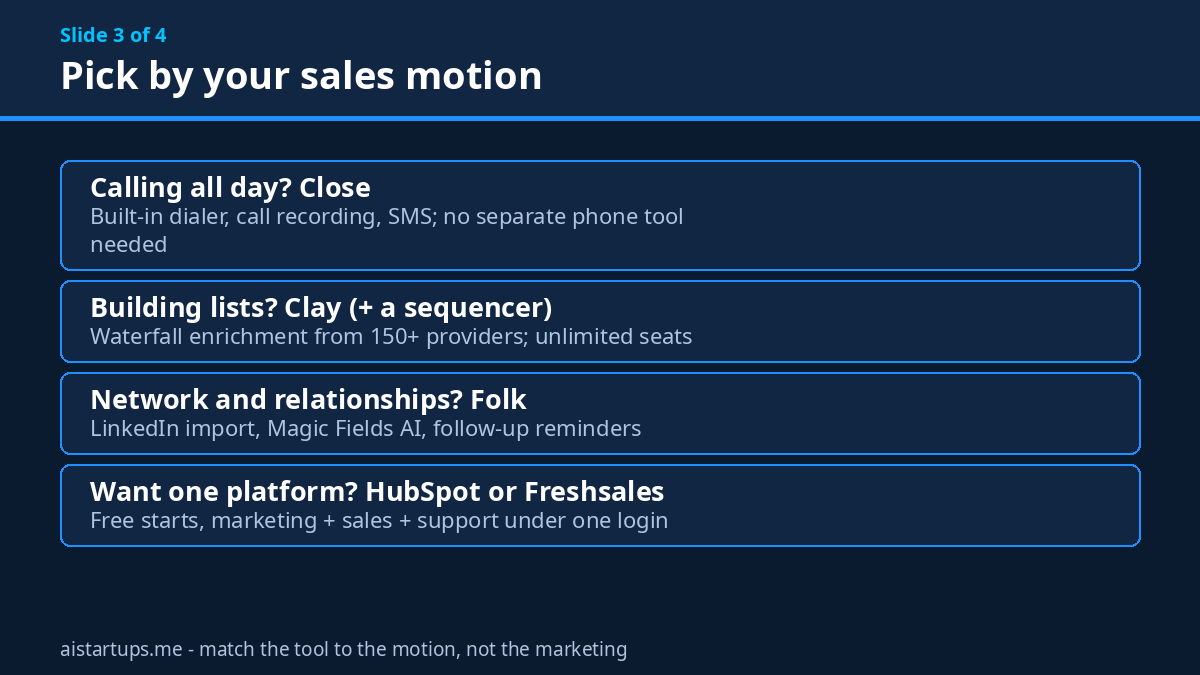
- What’s your sales motion? Calling all day → Close. Building targeted lists → Clay plus a sequencer. Selling through your network → Folk. Wanting one platform for everything → HubSpot or Freshsales. The tool has to match how you actually sell, because a CRM your team won’t open is a very expensive spreadsheet.
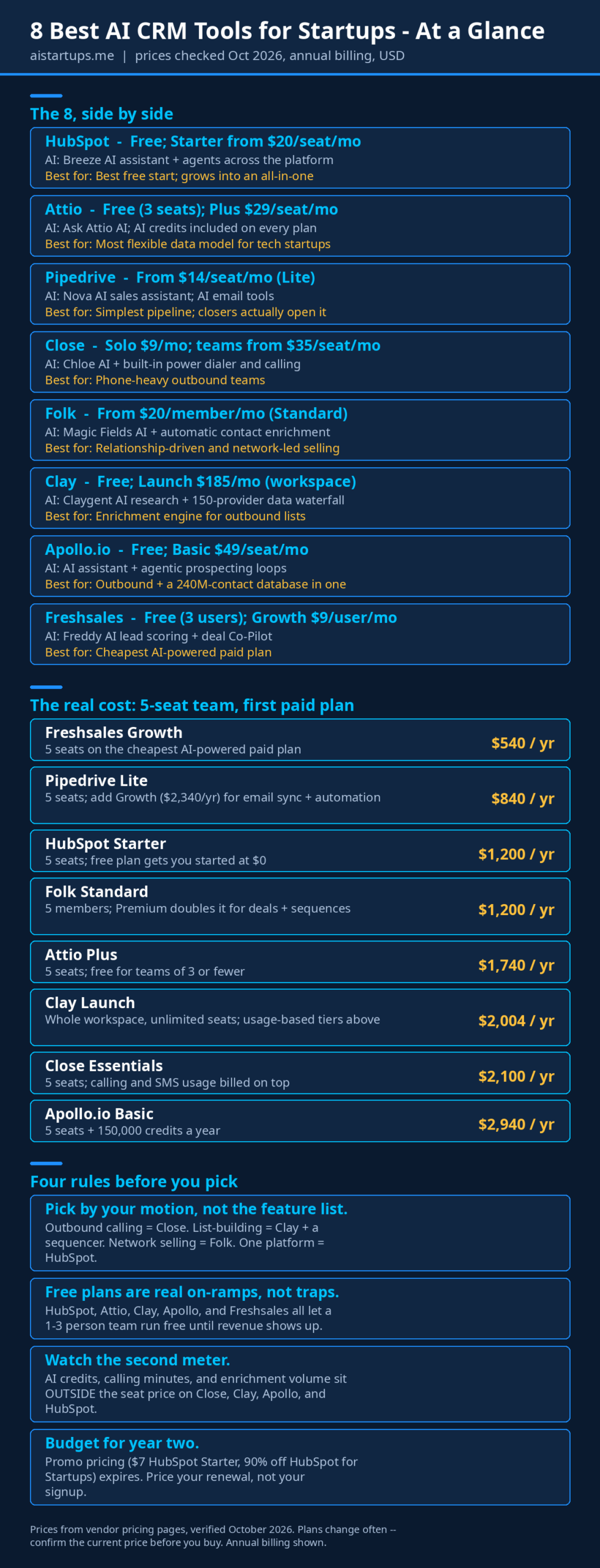
- What’s your real team size for the next 12 months? If it’s 1–3 people, five of these eight have free plans that carry you until revenue arrives — don’t pay for seats you don’t have yet. Price the 5-seat version too, though; the infographic above shows what year one really costs.
- Where’s the second meter? This is the 2026 question. AI credits, calling minutes, and enrichment volume sit outside the seat price on Close, Clay, Apollo, and HubSpot. Model a heavy-usage month before you commit, not an average one. We wrote a whole guide on the psychology of AI product pricing — the “second meter” problem shows up in CRMs exactly the way it shows up in AI tools.
- Can you leave? Check the export story before you import a single contact. CSV export, API access, and no data hostage-taking should be table stakes — confirm it on the trial, not after a year of pipeline history.
“As one recent CRM comparison put it: three of five leading AI CRMs put the agent inside the plan — the other two bill the seat, then bill the work. That second bill is the number most founders never model.”
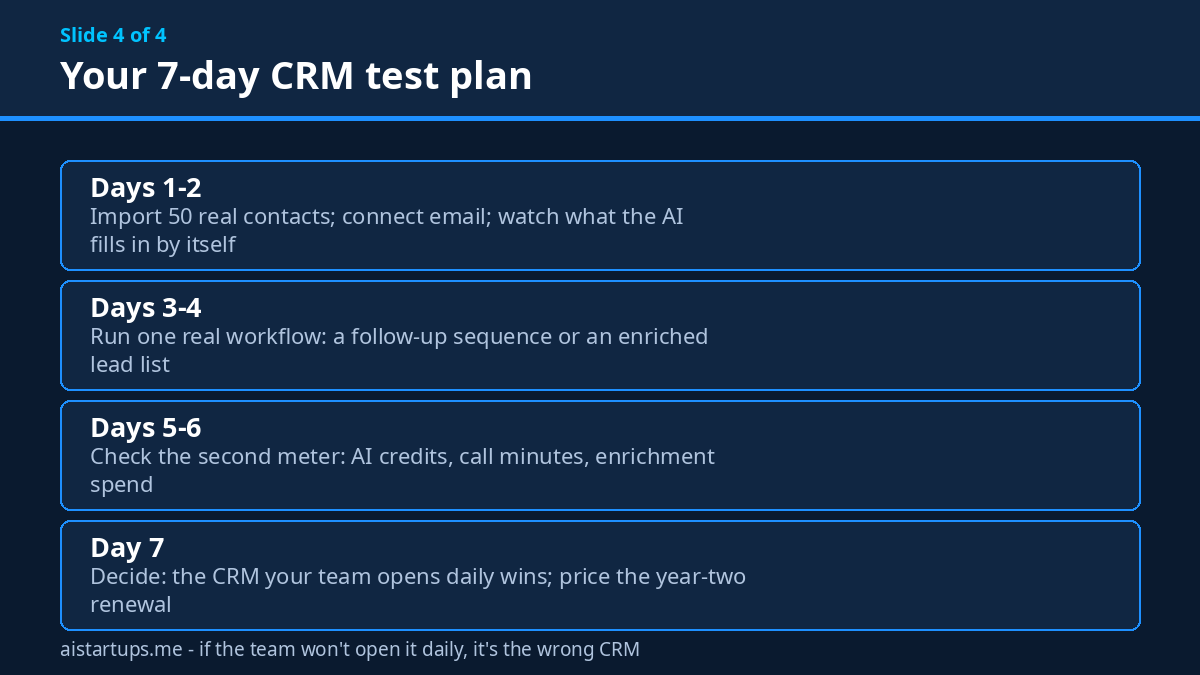
That quote stuck with me because it names the exact trap. The seat price is marketing; the total cost of ownership is the truth. When you trial any of these, run your heaviest realistic week in week one and read the usage dashboard like a bill — because it is one.
One more practical note: if your CRM rollout is really a website problem in disguise — you need landing pages, a launch-ready site, or onboarding pages behind the pipeline — a web development studio like AISquadX can ship that without eating your month. Don’t let a missing website delay the CRM decision; they’re separate jobs.
Mistakes Founders Keep Making
Buying for the team you’ll have in two years
You are three people, not thirty. Buy the CRM that serves three people brilliantly and migrates cleanly — that’s HubSpot’s free tier, Attio’s free plan, or Freshsales Growth. The enterprise tier will still be there when you need it, and you’ll negotiate it better with revenue behind you.
Ignoring the second meter until the invoice
AI credits, call minutes, enrichment volume, extra seats for the intern — the seat price is the headline, not the bill. Every tool on this list except Folk and Pipedrive’s base tiers has meaningful usage-based costs. Model them.
Letting the loudest rep choose
Your best closer wants the power dialer; your marketer wants the automation suite; you want the cheapest thing. The tiebreaker is adoption: the CRM the whole team will open every day wins, even if it’s not anyone’s first choice. A perfect CRM with 40% adoption loses to a good-enough CRM with 95% adoption.
Skipping the export test
On day one of the trial, export everything. If it’s painful, confusing, or lossy, walk away — that pain compounds over years. This takes ten minutes and almost nobody does it.
Frequently Asked Questions
What is the cheapest AI CRM for a startup?
Freshsales Growth at $9/user/month on annual billing ($540/year for five seats) is the cheapest paid plan with real AI features on this list. But five of the eight tools — HubSpot, Attio, Clay, Apollo.io, and Freshsales — have free plans, so the cheapest option for a 1–3 person team is $0 until revenue arrives. Start free; pay when the pipeline justifies it.
Do I even need a CRM as an early-stage startup?
If you’re tracking more than ~30 active conversations, yes. Spreadsheets break down fast: no follow-up reminders, no shared context when someone’s sick, no record of what was promised. The founders who say “we’ll get a CRM later” usually mean “we’ll reconstruct three months of lost context later.” Start free, start now.
Which AI CRM is best for outbound sales?
It depends on your channel. Phone-heavy outbound: Close, for the built-in dialer and calling. Email-heavy outbound with custom targeting: Clay for enrichment paired with a sequencer, or Apollo.io for database plus sending in one product. Network and warm outbound: Folk. There isn’t one winner — there’s the winner for your motion.
Are free CRM plans actually usable, or just trials in disguise?
The free plans from HubSpot, Attio, Apollo.io, and Clay are genuinely usable — real pipelines, real contacts, real AI features with limits. Attio’s free tier (3 seats, 50,000 records) is a complete CRM for a tiny team. What free plans don’t give you is scale: seats, automation depth, and usage credits are where the paid tiers earn their keep.
How much should a 5-person startup budget for a CRM?
Based on October 2026 pricing, a 5-seat team pays $540–$2,940/year on the first paid tier depending on the tool — Freshsales Growth at the bottom, Apollo.io Basic at the top — before usage costs like calling minutes, AI credits, or enrichment volume. Budget the seat price plus a 20–30% usage buffer, and price your year-two renewal, not just the signup offer.
The Bottom Line
There’s no single best AI CRM for early-stage startups — there’s the best one for your sales motion and your budget. If you want my short list: start free on HubSpot or Attio if you’re figuring out your motion; buy Freshsales Growth if you want the cheapest real AI plan; buy Close if your team lives on the phone; buy Clay if your problem is lead quality, not lead management.
The deeper point is the one the whole market is dancing around: the seat price stopped being the price. AI credits, calling minutes, and enrichment volume are where the real bill lives now, and the founders who model those in week one are the ones who don’t get surprised in month four. Run the trial like it’s already billing you — because next quarter, it will be.