


Real talk: if I see one more video promising “$10,000 a month with AI while you sleep,” I’m going to lose it.
Not because making money with AI is fake. It isn’t. I’ve watched freelancers, solo builders, and very ordinary people with day jobs turn AI tools into real income. The problem is the gap between what the hype promises and what actually lands in your bank account — and nobody talks about the stuff in between. The platform fees. The first three months of nothing. The fact that “passive income” is almost never passive.
So here’s the thing. I put together this list differently. Every hustle below has a realistic income range — what part-time earners actually report in months three through six, not what a guru’s best month looked like. Every one has a startup cost. And every one has an honest catch, because they all have one. If that’s the article you wanted, keep reading.
The Slide Deck Version (4 Slides)
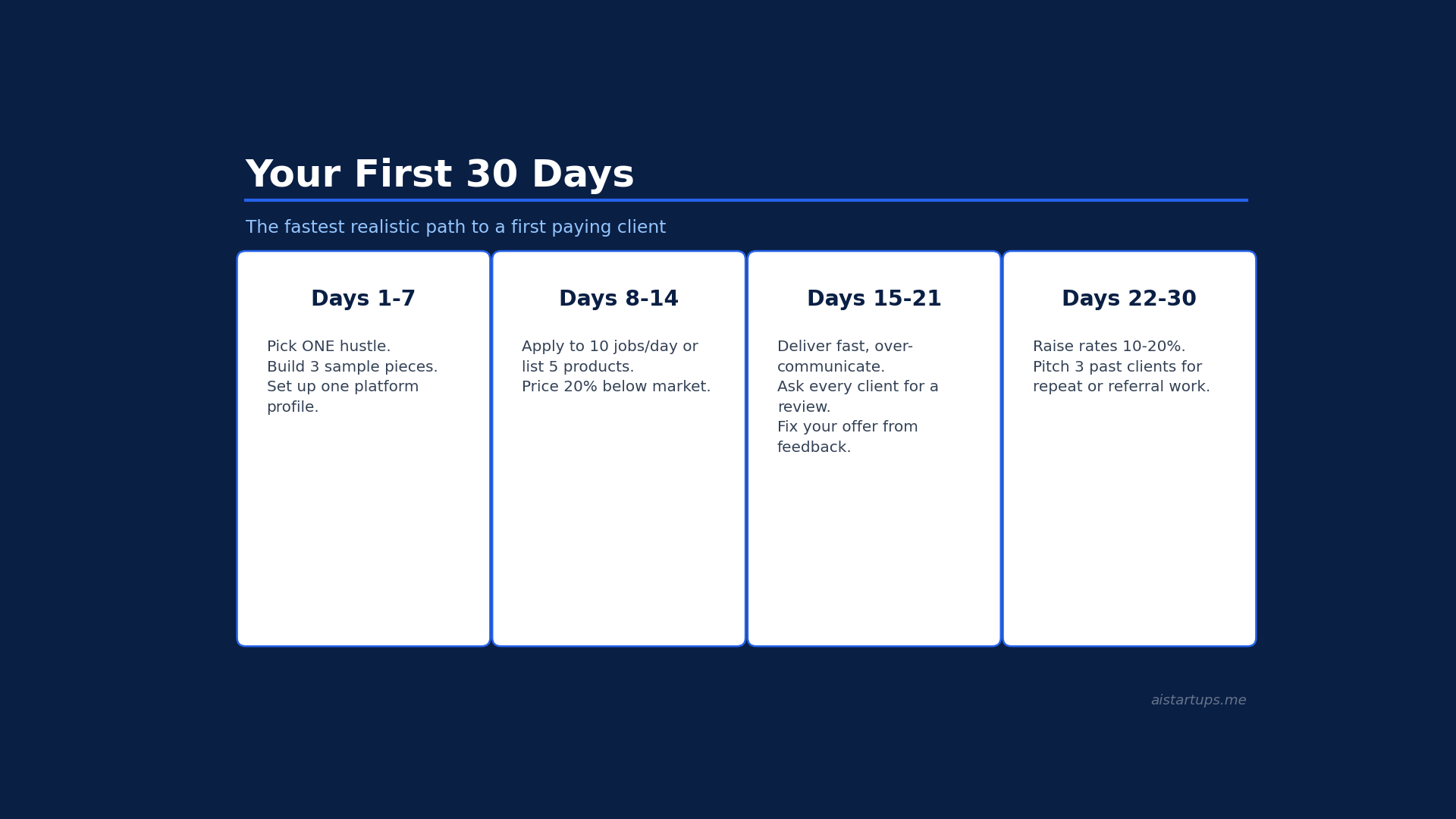
If you’d rather skim the framework first, here’s the whole playbook condensed: the fee math, how to pick your hustle, your first 30 days, and the three traps that kill most side hustles.
1. AI-Assisted Freelance Writing & Editing
The most boring pick on this list. Also the fastest way most beginners see their first dollar.
Here’s the deal: companies need blog posts, product descriptions, email sequences, and case studies. AI writes the first draft in minutes; you bring the judgment — fact-checking, voice, structure, the stuff that keeps it from reading like robot soup. Clients aren’t paying for words. They’re paying for publish-ready work they don’t have to touch.
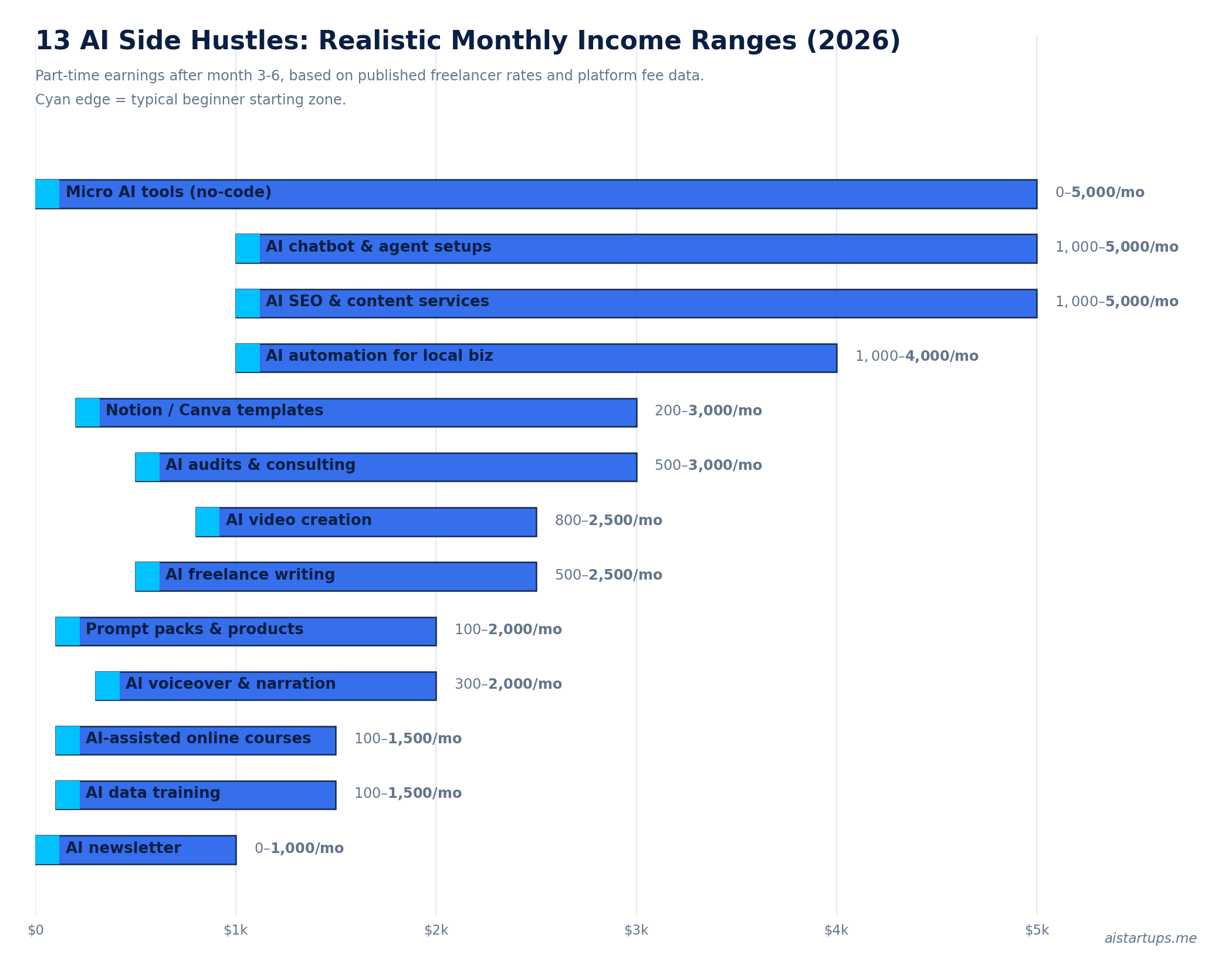
Realistic pay: $500–$2,500/month part-time by month 3–6. Beginners start around $20–$50/hour; specialists push past $75. The quickest first gigs usually come from Upwork or Fiverr, and a first paid job often lands within a week or two of consistent daily proposals.
Startup cost: $0. A free-tier chatbot and a Google Doc are genuinely enough to start.
The catch: Competition is brutal at the bottom. If your profile says “I use AI to write,” you’re competing with ten thousand identical profiles. Win by niching down — “I write email sequences for dental clinics” beats “I do AI writing” every single time.
2. AI Automation Setups for Local Businesses
This one’s my favorite for people who are even slightly technical. Small businesses — dentists, gyms, real estate agents, plumbers — are drowning in repetitive admin: missed calls, unanswered DMs, manual appointment booking, quote follow-ups that never happen.
You sell them a fix, not a tool. A lead-capture chatbot on their website. An automated review-request flow. A system that texts new leads within two minutes. You build it with no-code tools (Make, Zapier, n8n) plus an AI model for the conversational parts, charge a setup fee plus a monthly retainer for maintenance. It’s one of the AI services you can sell to local businesses this month with almost no audience required — you just walk in (or DM) and show them the money they’re leaving on the table.
Realistic pay: $1,000–$4,000/month part-time. AI automation freelancers report $60–$150/hour, and even two or three small retainer clients at $300–$500/month each add up fast.
Startup cost: $0–$50/month. Free tiers cover your first couple of clients.
The catch: You become tech support. Automations break, APIs change, clients panic at 11 PM. Price the retainer to cover the hand-holding, or you’ll resent every client you sign.
3. AI Voiceover & Narration
YouTube channels, course creators, and ad agencies need voices — lots of them. Modern AI voice tools sound good enough now that “AI-narrated” isn’t an insult, and creators happily outsource the whole audio pipeline: script polish, narration, basic mastering.
Realistic pay: $300–$2,000/month part-time once you have a few regular clients. Per-project pricing ($50–$200 for a 10-minute narration) is common.
Startup cost: about $6/month. ElevenLabs’ Starter plan runs $6/month (roughly $5 billed annually) with 30,000 credits — about 30 minutes of speech — and includes the commercial license you need to legally sell the output. The free tier doesn’t allow commercial use, so don’t skip this step. ElevenLabs’ current pricing is worth checking before you commit, since the credit math changes by model.
The catch: You’re one policy change away from disruption — platforms and clients can get squeamish about synthetic voices. Diversify with editing and script services so you’re not 100% dependent on one tool’s output.
4. AI Data Training & Annotation
Every AI lab needs humans to rate, rank, and correct model outputs. Platforms like DataAnnotation and Outlier pay you per completed task — comparing answers, writing prompts, checking reasoning. No clients, no marketing, no portfolio. Just show up and do the work.
Realistic pay: $100–$1,500/month. Occasional task-takers report around $50/month; people who qualify for specialized projects (coding, STEM, professional domains) can clear $2,000+ in a good month.
Startup cost: $0.
The catch: The task flow is inconsistent. Some weeks you’re drowning in work; some weeks the queue is empty. This works as a side gig or a cash bridge while you build something steadier — not as a plan A. This breakdown of AI income methods puts it well: freelancing pays fastest, data training fills gaps.
5. Prompt Packs & Niche Digital Products
Generic “1000 ChatGPT prompts” packs are dead — that market drowned in 2024. What’s alive: hyper-specific packs for a defined job. Prompts for real estate listing descriptions. Email templates for wedding planners. A Notion-plus-prompts system for freelance bookkeepers. The narrower, the better.
Realistic pay: $100–$2,000/month. Most sellers start slow (a few sales a week), and the ones who break $1,000/month usually have an audience or a traffic source — a newsletter, a YouTube channel, even a busy Reddit presence.
Startup cost: $0 to list. But know the fees before you price: Gumroad takes 10% + $0.50 per direct sale, plus card processing of roughly 2.9% + $0.30 — an effective rate near 13% on a typical sale, and a flat 30% on sales through its Discover marketplace, per current fee breakdowns. On a $29 product sold through your own link, expect to keep about $24.50.
The catch: No traffic, no sales. A digital product without distribution is a file on your hard drive. Build the audience (or the SEO, or the Etsy listing) first — or at least in parallel.
6. Notion Templates & Canva Assets
Same digital-product game, different storefront. Notion templates (freelancer CRMs, content calendars, habit systems) and Canva template packs (social media kits, pitch decks, resumes) sell steadily because buyers can see exactly what they’re getting. AI speeds up your research and design iteration; your taste and niche knowledge are the actual product.
Realistic pay: $200–$3,000/month. Template sellers in the $19–$49 price band report the best volume-to-effort ratio.
Startup cost: $0–$20. Etsy charges $0.20 per listing, a 6.5% transaction fee, and about 3% + $0.25 for payment processing in the US — roughly 10–12% all-in before ads. Gumroad’s numbers are in the same neighborhood.
The catch: Copycats. Popular templates get cloned within weeks. Your moat is continuous improvement and a brand buyers trust — not any single template.
7. Chatbot & AI Agent Setups
A step up from hustle #2 in complexity and pay: building actual AI agents for businesses — support bots trained on their docs, lead-qualification agents, internal knowledge assistants. The tools (ChatGPT’s custom GPTs, Claude projects, open-source agent frameworks) handle the heavy lifting; you handle scoping, prompt design, testing, and the unglamorous work of making it not hallucinate about the client’s refund policy.
Realistic pay: $1,000–$5,000/month part-time. Project fees of $1,500–$5,000 per build are normal for small businesses, plus retainers.
Startup cost: $20–$100/month for AI subscriptions while you build.
The catch: Scope creep is the silent killer. “Can the bot also do our invoicing?” Define the deliverable in writing before you start. And if a client ever wants something bigger — a full AI integration woven into their website or operations rather than a standalone bot — that’s specialist territory. It’s exactly what an AI integration studio like AISquadX does for clients: building custom AI features into real products instead of bolting on a template.
8. AI Video Creation Services
Faceless YouTube channels, course creators, and small brands need a constant stream of video. AI handles scripting, voiceover, and rough cuts; you handle the edit, pacing, thumbnails, and the judgment calls that make a video watchable instead of merely generated. Short-form (Reels, Shorts, TikTok) is the hungriest market — businesses will pay monthly retainers for 20–30 shorts a month.
Realistic pay: $800–$2,500/month part-time with 2–4 retainer clients.
Startup cost: $0–$50/month. Free tiers of most AI video generators cover your first projects; upgrade when a client is paying for it.
The catch: This is deadline-driven work. Retainers mean delivery calendars, and “the AI was slow today” is not an excuse clients accept. Build buffer into every timeline.
9. AI SEO & Content Services
Small businesses know they need content; they don’t have time to make it. You offer a package: keyword research, AI-drafted articles, human editing and fact-checking, publishing, basic on-page SEO. The AI does the 80% fast; your expertise is the 20% that makes it rank instead of embarrassing them.
Realistic pay: $1,000–$5,000/month part-time. Four clients at $500–$1,000/month retainers is the classic shape of this business.
Startup cost: $20–$100/month for AI and SEO tooling.
The catch: Google’s stance on AI content keeps evolving, and thin AI content gets crushed. If your deliverable is “30 articles, no editing,” you’re selling something with a short shelf life. Sell the editing and strategy — that’s the durable part. If you’re serious about the content game long-term, these profitable AI startup ideas show where services like this can grow into a real company.
10. AI-Assisted Online Courses
AI collapses course-creation time: outlines, scripts, quizzes, worksheets, even slide drafts. You bring the actual expertise — the thing you know that a chatbot doesn’t. Record once, sell for years. The classic semi-passive play, emphasis on “semi.”
Realistic pay: $100–$1,500/month in the first year for most new instructors. A small percentage break out; most don’t.
Startup cost: $0 to publish on Udemy. But read the revenue share before you celebrate: instructors keep 37% of an organic marketplace sale, 97% when the student comes through your own coupon link, and 15% on Udemy Business subscription revenue. Udemy also discounts your course constantly — your $199 course will mostly sell at $10–$15. The platform is a discovery engine you rent, not a business you own.
The catch: You don’t own the student relationship — no emails, no upsells, no second product. Smart course creators use Udemy as a lead generator and sell the real offer (coaching, community, advanced course) on their own site.
11. Niche AI Newsletter
Pick a niche you actually care about — AI tools for accountants, AI news for teachers, automation ideas for e-commerce — and write the best weekly email in that tiny world. Monetize with sponsorships and affiliate deals once you have a few thousand engaged readers.
Realistic pay: $0–$1,000/month, and the $0 phase lasts 6–12 months. This is the slowest money on the list and I won’t pretend otherwise.
Startup cost: $0. Beehiiv and Substack both have free tiers that cover you until you’re big enough to matter.
The catch: Consistency is the whole game. One great issue means nothing; fifty good ones mean everything. If you won’t write weekly for a year without pay, pick a different hustle.
12. AI Audits & Consulting
Walk into a business (figuratively or literally), spend a week mapping how they work, and hand them a report: “Here are the seven places AI saves you 20 hours a week, in priority order, with costs.” Charge $500–$1,500 for the audit. Half of them will then pay you to implement it — which is hustles #2 and #7 wearing a nicer suit.
Realistic pay: $500–$3,000/month part-time. Specialized consultants report $75–$150+/hour once they have case studies.
Startup cost: $0. Your brain is the product.
The catch: You need credibility to sell advice. Your first two audits should be cheap or free in exchange for testimonials and a case study you can show the next prospect. Nobody pays $1,500 for an audit from a stranger with no proof.
13. Micro AI Tools (No-Code)
The highest ceiling on this list — and the highest variance. Build a tiny tool that solves one painful problem: an AI contract summarizer for freelancers, a listing-description generator for Etsy sellers, a meeting-notes formatter for consultants. Launch on a no-code stack, charge $9–$29/month, and let it compound.
Realistic pay: $0–$5,000/month. Most micro-tools make little; a few become real businesses. The honest expected value for a first-timer is closer to the low end — but the skills compound into everything else on this list.
Startup cost: $0–$50/month for hosting and AI API credits.
The catch: Building is the easy 20%. Distribution is the other 80%, and most builders skip it. Validate before you build — talk to 10 potential users before you write a line of config. If you can’t find 10 people with the problem, you don’t have a product.
How to Actually Pick One (60 Seconds)
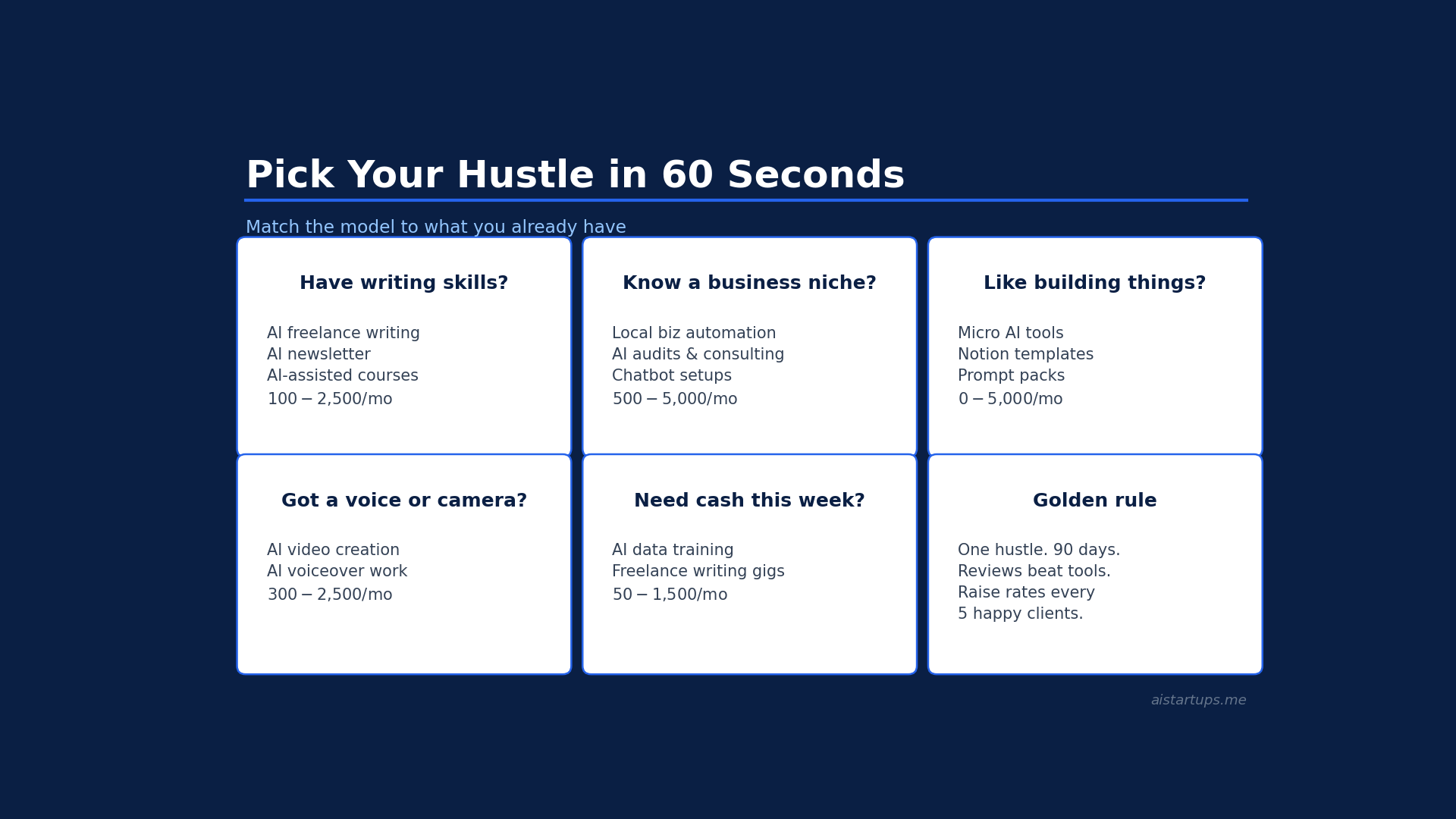
Don’t pick the one with the biggest number. Pick the one that matches what you already have:
- You can write? Start with #1 (freelance writing) or #11 (newsletter). Fastest feedback loop.
- You know a business niche? Go with #2 (local automation) or #12 (audits). Niche knowledge beats AI skills.
- You like building things? Try #5 (digital products) or #13 (micro tools). Higher ceiling, slower start.
- You need cash this week? #4 (data training) plus #1. Unsexy, immediate.
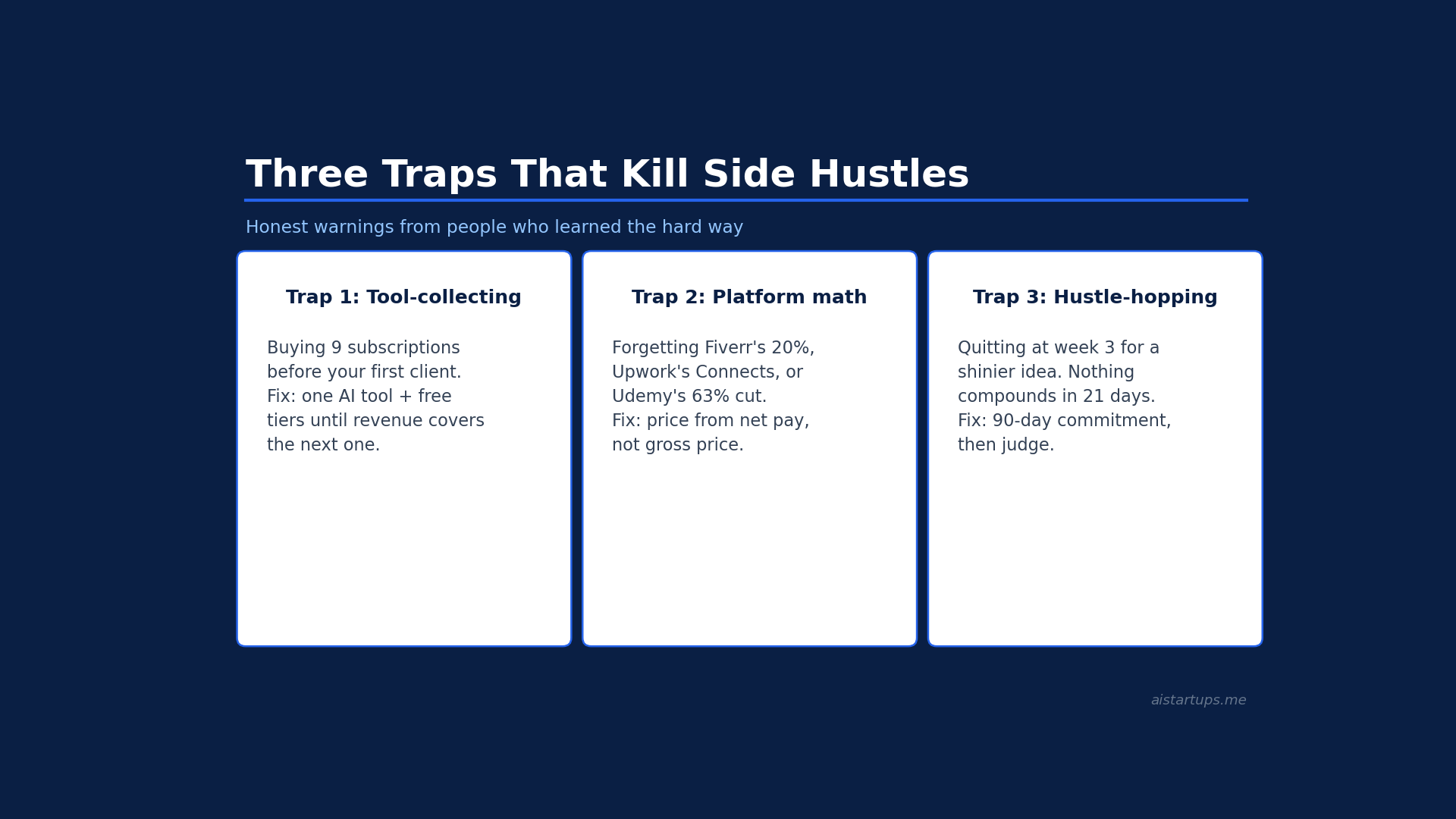
Then commit for 90 days. One hustle. Not three. The people who fail at this almost always fail the same way: they try writing for two weeks, switch to prompt packs for ten days, then start “researching” AI agencies. Nothing compounds in 21 days. Pick, commit, and let the boring work stack up.
One more thing on tools: you need fewer than you think. A solid general model subscription, the AI tools every founder should know, and free tiers for everything else. Every subscription you buy before your first client is just a tax on your impatience. Let revenue pay for the upgrades.
“The best side hustle isn’t the one with the highest income ceiling — it’s the one you’ll still be doing on day 90, when the novelty is gone and only the system remains.”
The Costs Nobody Puts in the Headline
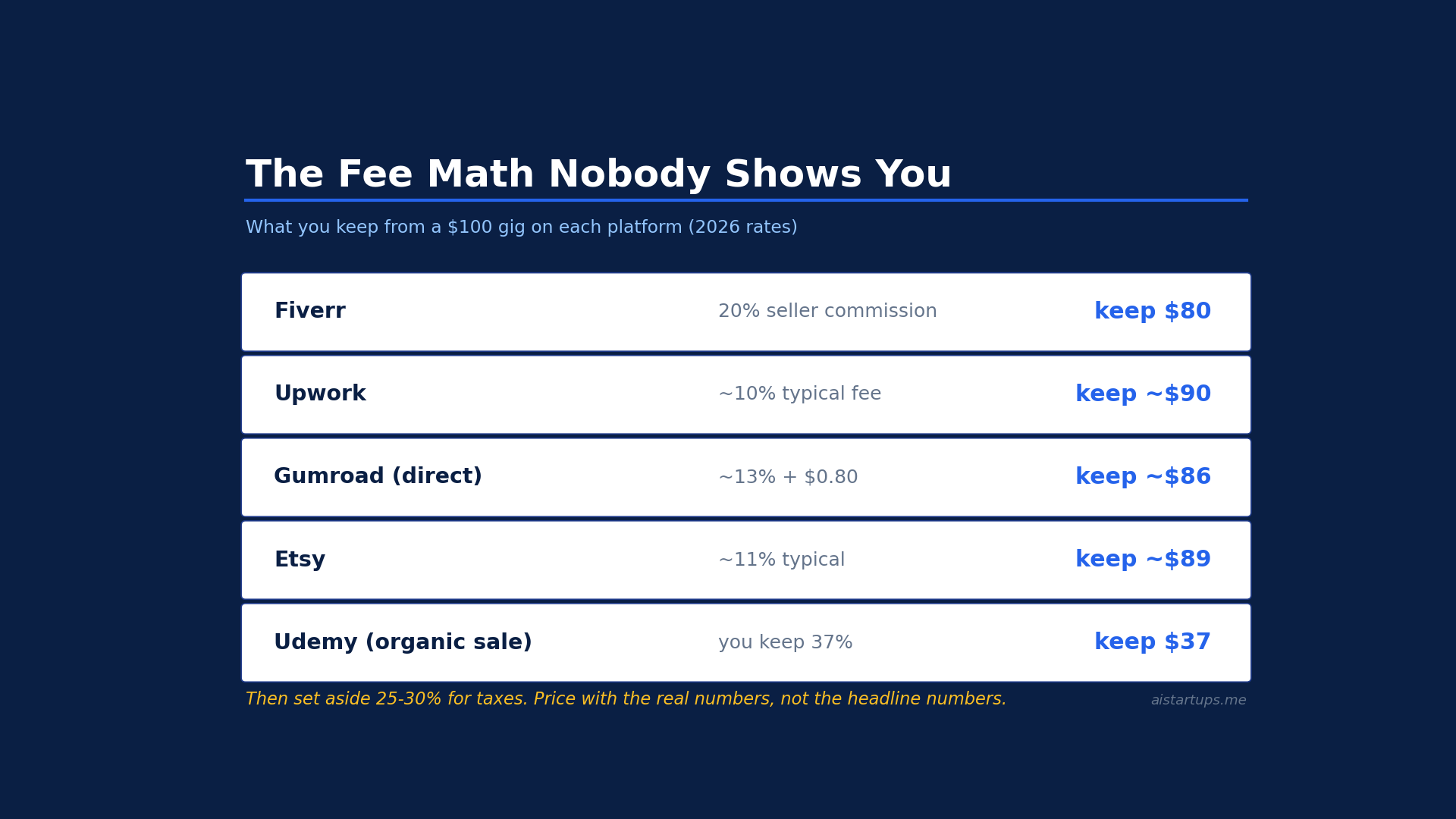
Let’s do the math the gurus skip. Say you land a $100 gig:
- Fiverr: the platform takes a flat 20% seller commission — you keep $80. (Buyers also pay a 5.5% service fee plus a small-order fee, which quietly raises your effective price.) Fiverr’s full fee breakdown is worth reading before you price anything.
- Upwork: a variable service fee of 0–15% per contract, typically around 10% — you keep roughly $90, minus the Connects you spent to win the job ($0.15 each, several per proposal). Upwork’s variable fee explained shows the full stack.
- Gumroad (direct sale): about 13% + $0.80 in combined platform and processing fees — you keep roughly $86.
- Etsy: roughly 10–12% all-in — you keep about $88–$90.
- Udemy (organic sale): you keep 37% — $37. Yes, really.
Then taxes. In the US, set aside 25–30% of side income for self-employment tax. Realistic side-hustle income guides consistently flag this as the thing beginners forget until April hurts.
None of this kills the opportunity. It just means you price from your net, not the gross. A $50/hour rate on Fiverr is really $40/hour before taxes. Know that going in and you’ll never feel cheated.
FAQ
How much can you realistically earn from AI side hustles?
For part-time effort (10–15 hours a week), most people land between $500 and $3,000/month by months 3–6, depending on the hustle. Beginners often start around $200–$400/month in the first 60 days. The $10,000/month screenshots are real for a tiny minority with audiences, retainers, or products — they’re not a plan, they’re an outcome.
Do you need coding skills to make money with AI?
No — for most of the hustles on this list. Writing, data training, templates, voiceover, and no-code automation all run on tools with free tiers and no programming. Coding (even basic Python or JavaScript) opens the door to the higher-paying end — custom integrations, data work, micro-tools — so it’s worth learning eventually, but it’s not the entry ticket.
What’s the fastest AI side hustle to start making money?
AI-assisted freelance writing on Upwork or Fiverr. A first paid gig often lands within one to two weeks of steady daily proposals, because clients buy outcomes (finished articles, edited drafts) and the deliverable is fast to produce. AI data training platforms are similarly fast to start, though the work is less consistent.
Which platform is better for beginners: Upwork or Fiverr?
It depends on your starting capital. Fiverr costs nothing to start — you list gigs and wait for buyers — but takes a flat 20% of every order. Upwork lets you pitch clients directly, which is faster for proactive people, but you pay for Connects to submit proposals (around $0.15 each, several per application) plus a ~10% service fee. If you’re bootstrapping from zero, Fiverr’s free entry wins; if you can spend a little to pitch, Upwork usually converts faster.
Are AI side hustles saturated in 2026?
The generic ones are. “I write with AI” and “1000 prompts” are crowded markets with collapsing prices. The specific ones aren’t — AI automation for dental clinics, Notion systems for real estate agents, voiceover for a particular YouTube niche. Saturation is almost always a sign you’re positioned too broadly, not that the opportunity is gone.
The Bottom Line
Look — none of these will make you rich by Friday. But that’s not the point. The point is that the barrier between “I use AI” and “AI pays me” has never been lower: free tools, free distribution, and clients who genuinely need help they can’t hire full-time for.
Pick one hustle from this list. Give it 90 days. Price from your net, not the gross. Get five happy clients, raise your rates, and repeat. That’s the whole secret, and it’s been the whole secret for every working freelancer I’ve ever met.
The hype will keep promising overnight money. You don’t need overnight money. You need a second income stream that actually exists — and now you know exactly what each one costs, pays, and demands. Go build it.