


Here’s a number that’ll mess with your head: your first 1,000 users will probably cost you $0. Not because ads are cheap (they’re not — they’ve never been more expensive), but because the channels that actually work before you have traction don’t accept money as payment. They take something else: nerve, consistency, and a willingness to look a little unpolished in public.
I’ve watched this pattern play out enough times to call it a rule. The founders who spend their first $5K on Facebook ads before they have 100 users? They’re not buying growth. They’re buying the feeling of doing marketing. The founders who grind out their first thousand users by hand — replying in communities, doing embarrassing direct outreach, launching in public — end up with something money can’t buy: they actually know who their customer is, what words make them click, and why they stay.
Look, I’m not romanticizing broke-ness. Money helps. But there’s a real argument that $0 marketing at the start is a feature, not a bug. Paid traffic masks every signal you need. When someone converts from an ad, you learn nothing about them. When someone converts because you answered their question in a Discord server at 11pm, you learn everything — their exact words, their real objection, the moment they decided to trust you.
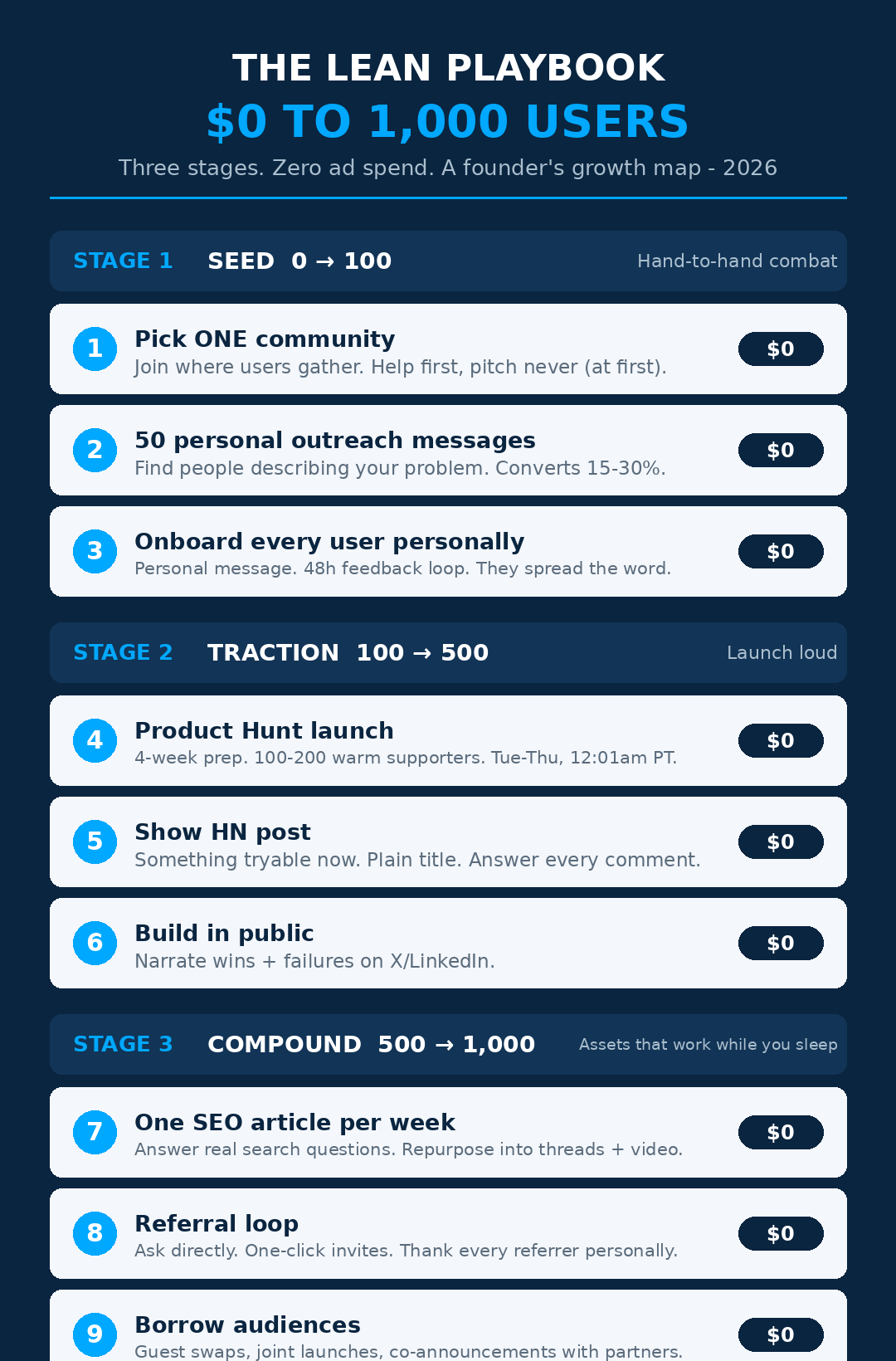
So this is the playbook. Three stages, zero dollars, one thousand users. Let’s go.
First, the Mindset Shift: Marketing Isn’t What You Think It Is
Forget everything you know about marketing from working at a company with a brand. Early-stage startup marketing is not about reach, impressions, or “brand awareness.” You have no brand. You have no budget. You have no sales team. What you do have: speed, direct access to the founder (you), and the ability to do things that don’t scale.
The whole game from 0 to 1,000 is about finding your first 100 users who love you enough to tell other people. Everything else — the launches, the content, the SEO — is just amplification of that core. Get the first hundred right and the road to a thousand is mechanical. Get them wrong and no tactic saves you.
And one more thing before the tactics: validate the idea before you spend a dollar marketing it. Marketing a product nobody wants is just efficient failure.
Stage 1: 0 to 100 Users — Hand-to-Hand Combat
This stage has no shortcuts and no dignity. It’s you, personally, finding users one conversation at a time. Embrace it. The founders who skip this stage always pay for it later, usually in the form of a product nobody can explain.
Find Your One Community
Your users already gather somewhere. One specific subreddit, one Discord server, one Slack group, one corner of LinkedIn. Not five places — one. Your job for the first two weeks is to join it, help people genuinely, and not mention your product once. Seriously. Not once.
This feels slow. It’s not. Those two weeks of pure giving buy you something priceless: context. You learn the community’s language, its inside jokes, what gets upvoted and what gets you flamed. When you finally do share your thing, you won’t sound like a marketer dropping in. You’ll sound like a member who built something.
Then publish your launch post in that community — not a polished press release, but a genuine story. What problem were you hitting? Why did you build this? What did you try that failed first? Authentic founder stories outperform polished launch copy every single time. People can smell a template from three paragraphs away.
Direct Outreach That Doesn’t Feel Gross
Cold outreach has a terrible reputation because most of it is terrible. Here’s the version that works: find 50 people describing your exact target problem on X, Reddit, or LinkedIn — not vaguely adjacent problems, your exact problem — and send each one a personalized note offering to help. Not a pitch. Help.
The math on this is honestly encouraging. Well-targeted, personal outreach to people actively complaining about your problem converts at 15-30%. That’s 10 to 15 beta users from 50 messages. Compare that to the conversion rate of your $500 ad test and tell me which one taught you more.
A quick note on tone: write like a human, not a sequence. “Hey, saw your post about X — I ran into the same thing and ended up building a small tool for it. Happy to share if useful” beats any three-email drip campaign. And when someone says no or ignores you? Move on. Volume with grace beats desperation every time.
Delight Them Personally
Once you have your first 20-50 users, do something unscalable: onboard every single one personally. A personal message. A check-in after a week. Act on their feedback within 48 hours and tell them you did.
These people become your word-of-mouth engine — but only if the experience feels personal. A founder who replies in 10 minutes is a story people tell their friends. A founder who sends an automated drip sequence is… every other SaaS.
- Talk to 50 potential users before you build the marketing plan. Ask where they currently solve this problem and what they hate about the existing options. Their answers are your positioning.
- Pick one community, not five. Depth beats breadth until you have 100 users.
- Do 50 pieces of direct outreach. Personal, helpful, zero automation.
- Onboard every early user like they’re your only user. Because right now, they basically are.
Stage 2: 100 to 500 Users — Launch Loud
You’ve got a hundred users who (hopefully) like you. Now it’s time to manufacture a spike. Launches are the one legitimate way to get a burst of attention for free — but only if you treat the launch as a campaign, not a post.
The Product Hunt Playbook
Product Hunt still matters in 2026, and here’s why it’s underrated: a good launch gets you 20 to 40 backlinks within a week from all the “best new tools” blogs and directories that scrape the daily leaderboard. That’s free SEO you can’t buy.
But the launch rewards preparation far more than luck. The current best practice, per 2026 launch guides from founders who’ve actually done it, is a four-week prep timeline:
- 4 weeks out: Pick your launch date (Tuesday-Thursday, avoiding holidays and big competing launches). Start building your “hunter list” — 100-200 people who’ll genuinely engage on launch day.
- 3 weeks out: Draft your tagline (under 60 characters, benefit-first), gallery images, and your first maker comment. Get 5-10 people to critique the listing draft.
- 2 weeks out: Line up a hunter with an audience if you don’t have 1,000+ followers yourself. Start teasing on X, LinkedIn, and your communities.
- 1 week out: Finalize assets, schedule promo posts, email your waitlist a heads-up. Confirm you’re launching at 12:01am PT.
- Launch day: Post at 12:01am PT, then spend the entire day replying to every comment within minutes. This is a 24-hour job, not a morning task.
One warning that matters more than ever: Product Hunt’s moderation actively strips fake upvotes now, and vote rings get caught within hours. Don’t buy votes, don’t mass-DM strangers the day before. A well-prepped launch from a nobody with 200 real fans beats a funded startup that cheated and got flagged by lunchtime.
Show HN: The Technical Crowd
If your product is even slightly technical, a Show HN post on Hacker News can outperform Product Hunt for qualified users. The official Show HN guidelines are short and worth reading in full, but the gist is: post something people can actually try right now (not a landing page, not a waitlist), use a plain factual title with no hype, and post your backstory as the first comment.
The culture rules are strict and that’s the point. As one 2026 Show HN guide puts it: write and behave like an engineer sharing something interesting, not a founder selling something. Delete every marketing-register word. Admit your limitations up front — on HN, admitting what your thing can’t do reads as competence. And never, ever ask for upvotes. The voting-ring detector penalizes the post and can shadow-kill the account.
“Anything that creates unnatural, synchronized voting behavior from unfamiliar accounts gets caught. Anything that channels real humans with real context to make their own decision is fine.” — the 2026 Product Hunt launch playbook, and honestly the same rule applies to every launch platform.
Build in Public (The Slow Launch That Never Ends)
Here’s the thing about launches: they’re one-day spikes. Building in public is the slow-burn version that compounds. Post your revenue numbers (or your $0 revenue numbers — honesty is the whole point), your failed experiments, your tiny wins. X and LinkedIn both reward this format heavily, and the audience you build becomes the hunter list for your next launch.
The founders who do this well aren’t performing vulnerability. They’re just… narrating. “Tried cold email this week, 2% reply rate, here’s the email.” That post will outperform your polished product announcement 10-to-1. Every time.
Stage 3: 500 to 1,000 Users — Make It Compound
Spikes are fun. Compounding is better. Stage 3 is where you stop chasing attention and start building assets that attract users while you sleep.
Content + SEO: The Slowest Fast Channel
Content marketing is the backbone of bootstrapped growth for one reason: it compounds. One genuinely useful article keeps attracting visitors for months or years. Zero-budget playbooks routinely cite the same math: content generates roughly 3x more leads than outbound methods at a fraction of the cost, because every piece is a permanent asset.
The workflow is dead simple and completely free:
- Do free keyword research (Google Keyword Planner, AnswerThePublic) on what your target users actually search.
- Write one genuinely helpful 1,000+ word piece per week answering a real question.
- Nail the basics: clear title, descriptive meta, subheadings, links to credible sources.
- Repurpose every piece into 2+ formats — a thread, a LinkedIn post, a short video.
- Refresh old posts quarterly.
Real talk: the unsexy part is the landing page everything feeds into. If your homepage leaks signups, no amount of community traffic saves you. Getting the page itself right — fast load, clear copy, a signup flow that works on mobile — is conversion work, and it’s the kind of thing a specialist web development studio like AISquadX handles for AI startups: building sites that actually convert the traffic you’re working so hard to earn.
Referrals: Turn Users Into Your Marketing Team
Nothing beats a recommendation from a friend, and the data backs it up: referred customers stick around longer and spend more. The good news is a referral system costs $0 to start:
- Delight first, ask second. Word-of-mouth starts with a product experience worth talking about.
- Just ask. A simple “if you like this, please share it” in your onboarding email goes shockingly far.
- Add a small perk. Extra features, extended trials, or even public recognition. It doesn’t have to be cash.
- Make it one-click. Pre-written tweets, easy invite links, an “invite a friend” button in the product.
- Thank every referrer personally. Recognition fuels the next referral.
Partnerships: Borrow Someone Else’s Audience
Partnerships are the most underrated $0 channel. The math is simple: if you each have 500 users and you cross-promote, you both potentially double your reach overnight. Guest content swaps, joint webinars, bundle offers, social shout-outs, in-product cross-promos — all free, all relationship-driven.
For AI startups specifically, partnerships have a natural shape: integrate with a complementary tool and co-announce it. If you sell to local businesses, partner with the agency or freelancer community that serves them. You’re not competing for attention; you’re sharing it.
What NOT to Do With Your $0 Budget
Equally important as the tactics: the traps. I’ve seen founders burn months on every one of these.
- Don’t run paid ads before product-market fit. Paid traffic stops the moment you stop paying, and until organic visitors retain, paid is just leaking money with extra steps. Paid ads should be fuel on a working fire, not a desperate spark.
- Don’t hire a marketing agency. Agencies sell the appearance of marketing. Before $50K MRR, marketing is the founder’s job — outsourcing it means you never learn what actually works.
- Don’t build a complex marketing stack. You don’t need a CRM, three analytics tools, and a six-step drip campaign for your first 100 users. You need a spreadsheet with their names.
- Don’t buy followers or engagement. Fake followers poison your audience signal, and the platforms detect it. So do your real prospects.
- Don’t launch on five platforms the same day. Reddit wants context, LinkedIn wants a story, Product Hunt wants a clean product page, HN wants substance. Copy-paste the same pitch everywhere and you lose credibility in all of them.
Your 30-Day $0 Sprint Plan
Theory is nice. Here’s the actual calendar. If you’re starting from zero today:
Week 1 — Research. Define your target user precisely (“10-person fintech startup CTO” beats “developers”). Find 3 communities where they hang out. Join, observe, post nothing. Learn the room.
Week 2 — Give. Reply to 30 conversations across your communities. Publish one long-form post about the problem your product solves — not the product, the problem. Cold-outreach 20 people with personalized, helpful notes.
Week 3 — Test. Have 5 customer conversations from your outreach. Publish a second post with what you learned. Soft-launch to your personal network. Start your Product Hunt prep if a launch is 4 weeks out.
Week 4 — Launch. Pick your launch channel and execute. Publish the recap. Follow up with every signup personally within 24 hours.
By day 30 you’ll have: a presence in 3 communities, 2 substantive pieces of content, 5+ real customer conversations, and probably your first users. That’s worth more than any $5K ad spend you could run pre-PMF. And if you’re still figuring out the business model underneath all this, our complete founder’s guide and pricing guide are good next reads.
Frequently Asked Questions
Can you really get 1,000 users with zero marketing budget?
Yes — with a big caveat. $0 marketing trades money for time, and it only works if you’re consistent for months, not weeks. Community building, direct outreach, launches, content, and referrals are all proven $0 channels. What doesn’t work is doing each of them once and declaring marketing “doesn’t work.”
How long does it take to get the first 1,000 users?
Honestly? Anywhere from 2 weeks to 6 months depending on the product and how much time you put in. A consumer app with a great Product Hunt launch can do it in weeks. A B2B tool built on SEO and partnerships might take months. The founders who quit at week three never find out which one they were.
Should I be on every social platform?
No. Pick one — maximum two — where your users already spend time. B2B usually means LinkedIn or X. Consumer means TikTok or Instagram. Being mediocre on five platforms loses to being excellent on one, every time.
When should I start spending money on marketing?
When you can answer three questions: who your customer is, what message converts them, and what they’re worth to you. Until then, paid spend masks the signals you need. Start paid only when organic channels are working and you want to scale what already converts.
What’s the single highest-leverage $0 tactic?
Direct, personal outreach to people actively experiencing your problem. Nothing else gives you users and market research at the same time. A close second: a well-prepped Product Hunt launch, which delivers users, backlinks, and social proof in one 24-hour sprint.
The Bottom Line
Your first 1,000 users won’t come from a budget. They’ll come from 50 awkward conversations, one community that trusts you, one launch you prepared for a month, and a handful of users who loved the product enough to tell a friend. It’s slower than ads and ten times more valuable — because by user 1,000, you won’t just have users. You’ll have a distribution playbook you built yourself, a message that’s been battle-tested in the wild, and the one asset no competitor can buy: you actually know your customer.
So close the ads manager tab. Open one community, write one helpful reply, and send one personal message today. That’s the whole playbook. The rest is just doing it again tomorrow.