


Here’s the thing nobody tells you when you open an online store: the storefront is the easy part.
Getting someone to click “buy” — that’s the fun part. The part with the screenshots and the dopamine. The hard part starts the second after checkout. The return email at 11pm. The “where’s my order” message from a customer who bought three weeks ago. The product that sold out Tuesday and sat dead for a month. The price you set in January that’s quietly losing you money in June.
I spent a lot of 2026 watching sellers build AI tools for the front of the store — better descriptions, prettier images, smarter chat popups. And look, that stuff helps. But the sellers who are actually pulling ahead are the ones pointing AI at everything that happens after the sale. That’s where the margins leak. That’s where the boring, repetitive, expensive work lives. And boring, repetitive, expensive work is exactly what AI is good at eating.
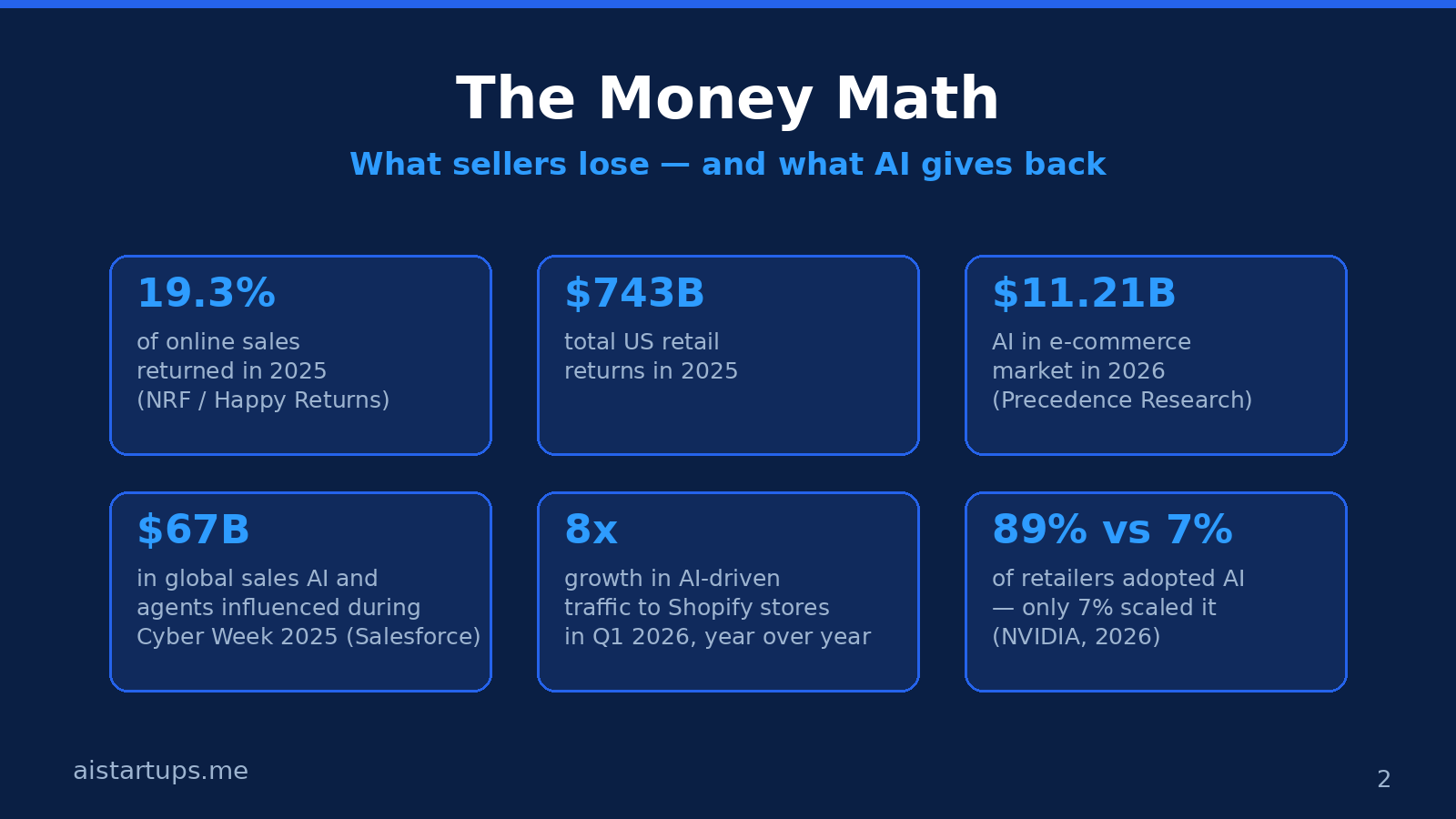
Real talk: the market agrees. The AI in e-commerce market is worth roughly $11.21 billion in 2026 and is projected to reach about $74.93 billion by 2035, per Precedence Research. NVIDIA’s State of AI in Retail 2026 found that 89% of retailers have adopted AI — but only 7% have scaled it. That gap between “we tried it” and “it runs our business” is the whole opportunity. The 7% are building systems. The 89% are still dabbling.
And shoppers are already there. Shopify reported that AI-driven traffic to stores grew 8x year over year in Q1 2026, with orders from AI-powered searches growing nearly 13x. Salesforce says AI and agents influenced $67 billion in global sales during Cyber Week 2025. EMARKETER puts AI platforms at about $20.57 billion in US retail e-commerce sales in 2026. The buyers have moved. The question is whether the tools on the seller side keep up.
So this list skips the storefront. No “AI product descriptions” idea — you already know that one. These are nine ideas that live beyond the buy button: returns, pricing, inventory, post-purchase, service, reviews. Each one is something a solo founder can actually start, with real tools and rough economics. Some of these I watched sellers build from scratch this year. A couple I tried myself (and yes, I messed one up — more on that below).
One note before we start: every number in this article comes from a named source — NRF, Salesforce, Shopify, NVIDIA, EMARKETER, Precedence Research, or the vendor’s own pricing. Where a number is a vendor’s claim or an analyst’s projection, I’ll say so. I don’t invent stats, and you shouldn’t trust anyone who does.
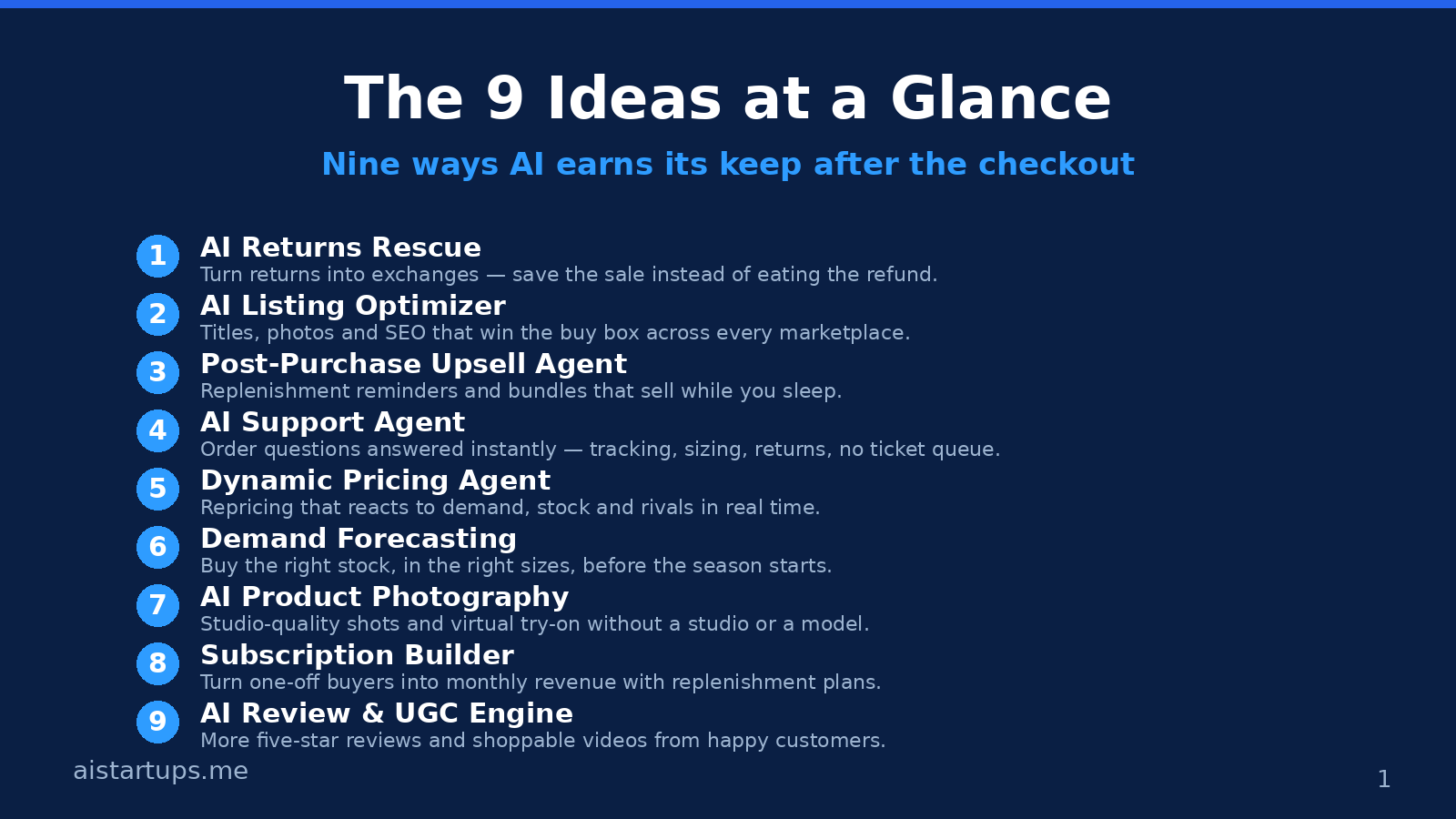
1. AI Returns Rescue — Smart Exchanges That Save the Sale
Let’s start with the ugliest number in e-commerce. Online returns run about 19.3% of online sales in 2025, versus 15.8% across all retail, according to NRF and Happy Returns’ 2025 retail returns data. Total US retail returns hit $743 billion, per the same report. And if you sell apparel or fashion, your online return rate is roughly 24–30%. One in four orders comes back.
Most sellers treat a return as a loss. The customer clicks “return,” you eat the shipping, you eat the restocking, and the money walks out the door. But here’s what the smart operators figured out: a return is a customer who already bought from you once. They’re not gone. They’re standing in your doorway holding a product that didn’t fit. What you do in the next sixty seconds decides whether that money stays with you.
That’s what an AI returns rescue tool does. Instead of a dumb return form, the customer gets a conversational flow: “The medium was too small? Here’s the large — same item, ships free, and we’ll hold your refund until the exchange lands.” Or: “That color didn’t work? These three similar styles are in stock, and two of them are on sale this week.” The AI reads the return reason, the order history, and live inventory, then steers the customer toward an exchange, a store credit, or a swap — instead of a refund.
Why does it work now? Because the pieces finally exist in one place. Return portals are mature, inventory APIs are standard, and language models are good enough to handle a frustrated customer without sounding like a robot reading a script. Five years ago this needed a team. Now it’s a workflow.
How a solo founder starts: pick one niche with brutal return rates — women’s apparel, footwear, or home goods are the obvious ones. Build the rescue flow as a Shopify app or a standalone widget that sits on top of an existing returns portal. Start with three paths: size exchange, style swap, and store credit with a small bonus (say, 10% extra credit). Measure one number: exchange rate. If your flow converts even a fifth of would-be refunds into exchanges, you’ve paid for yourself.
Rough economics: a seller doing 1,000 orders a month at a 25% return rate is processing 250 returns. If your tool rescues 20% of those as exchanges at an average order value of $60, that’s $3,000 a month in retained revenue. Charge a flat monthly fee or a small percentage of rescued revenue and the pitch writes itself. For context on what sellers already pay in this space, Loop Returns’ paid plans run $155 a month for Essential and $340 a month for Advanced, with an annual contract required, according to 2026 pricing roundups. That’s your competitive floor — a leaner rescue-focused tool can undercut it or charge for the outcome instead of the seat.
Tools to start with: Shopify’s returns APIs and a returns portal like Loop or AfterShip for the plumbing; a language model API for the conversational flow; and a simple analytics view showing rescued revenue, because that’s the number that renews the subscription. If you want a broader sense of where this kind of idea fits in the startup world, my roundup of profitable AI startup ideas for 2026 puts returns and post-purchase tools near the top of the list for a reason.
2. AI Listing Optimizer for Marketplaces
You list a product on Amazon, Etsy, eBay, and your own store. Same product, four listings, four different rulebooks. Amazon wants keyword-stuffed titles. Etsy wants story and craft. eBay wants specifics and condition notes. Your store wants clean and brand-led. Most small sellers write one listing and copy-paste it everywhere — then wonder why the marketplace listings underperform.
An AI listing optimizer fixes that. Feed it your product photos, your current listing, and your sales data. It rewrites the title, bullets, and description for each marketplace’s rules and ranking quirks, suggests the right category and attributes, flags missing keywords buyers actually search for, and scores the listing against top sellers in your niche. Then it keeps learning: when a tweak lifts conversion, it remembers what worked.
Why it works now: marketplaces change their ranking rules constantly, and no human can keep up across four platforms. AI can. And the data is all there — search terms, competitor listings, your own conversion rates. This is pattern-matching work, which is exactly what these models do well.
How a solo founder starts: don’t try to cover every marketplace on day one. Pick one — Amazon is the biggest prize, Etsy is the friendliest entry point — and build a genuinely good optimizer for it. Scrape (legally, through official APIs where available) the top 20 listings in a category, learn what they share, and build your scoring around that. Your first ten users should be sellers in one niche, like handmade jewelry or phone accessories, so your suggestions are specific instead of generic.
Rough economics: sellers pay for this in two ways — a monthly subscription or per-listing optimization. A seller with 200 SKUs will happily pay $30–50 a month if each optimized listing lifts conversion even slightly, because the math compounds across their whole catalog. The trap to avoid: charging per listing once and never seeing the customer again. Make it a subscription with ongoing re-scoring, so the value keeps arriving.
Tools to start with: each marketplace’s official API for listing data, a language model for rewriting, and a simple before/after conversion tracker. The honest pitch is “your listings get better every week, automatically.” If you’re still weighing which kind of AI business to build, this comparison of AI side hustles that actually make money is a useful reality check on what pays and what doesn’t.
3. Post-Purchase Upsell & Replenishment Agent
The cheapest customer you’ll ever get is the one who just bought from you. They’re warm. They trust you. Their card is already out. And most sellers do absolutely nothing with that moment except send a boring order confirmation.
A post-purchase upsell and replenishment agent watches what a customer bought, when they bought it, and how fast they use it — then shows up at the right moment with the right offer. Bought a serum that lasts about 45 days? Day 38, a friendly message: “Running low? Reorder in one tap, 10% off.” Bought a coffee maker? A week later: “The filters for your model are here, and here’s the descaler too.” Bought dog food? Every five weeks, like clockwork.
The key word is timing. A generic “you might also like” email sent at a random hour is spam. The same offer sent the day the product runs out is a service. AI makes the timing part possible at scale, because it can estimate consumption from product type, order history, and how similar customers behave.
Why it works now: email and SMS tools have the automation plumbing, and AI can now personalize the timing and the offer instead of blasting the same sequence to everyone. The result is a second sale that costs almost nothing to acquire — no ads, no discount spiral, just a well-timed nudge.
How a solo founder starts: build for one vertical where replenishment is obvious — consumables. Skincare, supplements, pet food, coffee, cleaning products. Integrate with Shopify and Klaviyo (Klaviyo’s free tier covers up to 250 active profiles and 500 email sends a month, with paid Email plans from $20 a month for 251–500 profiles, per their pricing). Your tool’s job: estimate the replenishment date, draft the message, and track the reorder rate. Sell it as “repeat revenue on autopilot” and show the dashboard number that matters — revenue from replenishment flows.
Rough economics: if your tool generates even $500 a month in extra repeat orders for a small seller, a $49–99 monthly fee is an easy yes. Scale it across 50 sellers and you’re looking at a real business. The catch? You need to be careful with frequency. One well-timed message a month is a service. Three a week is a quick way to get unsubscribed. Build in guardrails from day one — max one replenishment nudge per product cycle, and a one-tap “don’t remind me” option.
Tools to start with: Shopify order data, Klaviyo or similar for messaging, and a simple consumption model (product lifespan + order interval). Start with rules, add learning later — a rule that says “serum lasts 45 days” beats a fancy model that guesses wrong.
4. AI Customer-Service Agent for Order Questions
“Where is my order?”
If you run a store, you’ve read that sentence a thousand times. It’s the most common support question in e-commerce, and it’s also the most automatable. The answer lives in your order system. The customer just can’t find it, or doesn’t want to dig for it.
An AI customer-service agent for order questions handles exactly this slice of support — not everything, just the order-status universe. Where’s my order, can I change the address, can I cancel, what’s the return window, when will it ship. It pulls live data from the order system, answers in plain language, and hands off to a human the moment the question gets complicated or the customer gets upset. The handoff part matters more than the answering part. A bot that won’t let go is worse than no bot at all.
Why it works now: customers already expect instant answers, and the models are now reliable enough to read an order status and explain it without hallucinating a tracking number. The trick is grounding — the agent only answers from your actual order data, never from its imagination. That constraint is the whole product.
How a solo founder starts: scope it ruthlessly. Don’t build a general support bot. Build the order-question bot, and build it well, for Shopify stores doing 200+ orders a month. Those sellers are drowning in “where’s my order” tickets and they’ll pay to make them disappear. Integrate with Shopify, the shipping carrier’s tracking API, and one helpdesk (Gorgias or Zendesk). Your demo should be a live store where the bot answers ten real order questions flawlessly.
Rough economics: support is a cost center, so sell on saved hours. If a seller’s team spends 15 hours a week on order questions and your agent handles 70% of them, that’s roughly 10 hours a week back. Price against that — $79–149 a month for a small store is defensible when the alternative is hiring. And the retention is sticky: once the bot knows a store’s policies and tone, switching costs are real.
Tools to start with: Shopify and carrier tracking APIs, a helpdesk integration, and a language model with strict grounding (answers must cite the order record). Measure deflection rate honestly and show it weekly. One warning from my own experience: I once watched a seller launch a support bot that answered confidently about orders it couldn’t see. It invented delivery dates. Customers were furious. The fix was boring and essential — if the bot can’t verify it from the order system, it says so and escalates. Build that rule in before you launch, not after your first angry review.
For the bigger picture on how these tools fit together, the lean AI startup marketing playbook covers how small teams launch and sell exactly this kind of focused tool without a big budget.
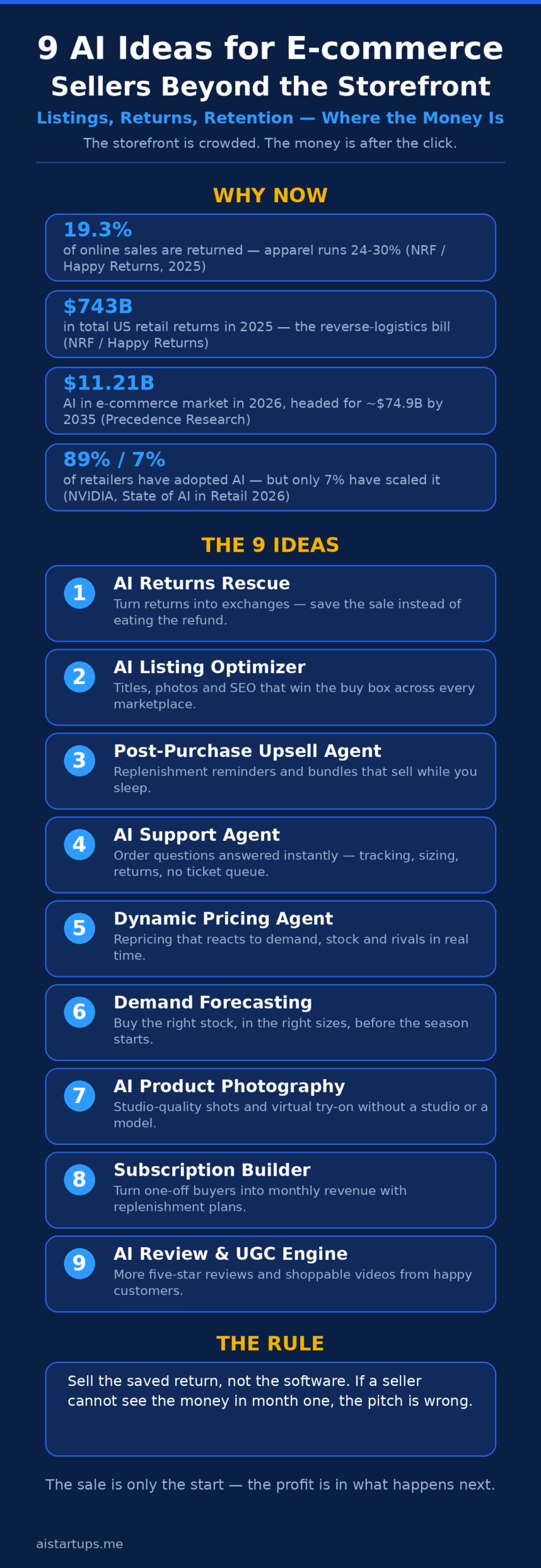
5. Dynamic Pricing & Repricing Agent
Here’s a quiet way sellers lose money every single day: their prices are frozen. They set a price in January, and it’s still there in June — while competitors changed theirs twelve times, while demand spiked and dropped, while their own stock ran low and then piled up.
A dynamic pricing and repricing agent watches all of that and adjusts. Competitor price drops? Match or undercut within your margin floor. Stock running low on a popular item? Nudge the price up slightly — scarcity is real and customers accept it when it’s modest. Slow-moving inventory? A gentle, time-limited cut to move it before it becomes dead stock. The agent never prices below your floor and never above your ceiling. You set the guardrails; it works inside them.
Why it works now: repricing used to be a big-seller game because it needed constant monitoring. AI plus marketplace APIs made the monitoring cheap. And buyers have accepted dynamic prices — they see them on flights, hotels, and ride-hailing every day. E-commerce is just catching up.
How a solo founder starts: pick sellers with real price competition — electronics accessories, supplements, or home goods on Amazon and eBay are good hunting grounds. Build the competitor-watch first, the repricing second. Your first version can be simple: check competitor prices twice a day, adjust within guardrails, log every change with a reason. Sellers need to trust the machine before they let it touch their prices, so transparency is the product. Show every change, why it happened, and what it earned.
Rough economics: on thin-margin categories, a 2–3% lift in realized price across a catalog is enormous. A seller doing $50,000 a month in revenue who gains 2% from smarter pricing adds $1,000 a month. Charge a percentage of the uplift or a flat fee tied to catalog size, and the ROI conversation is easy. The risk is real, though — a bug that reprices everything to $1 is a nightmare. Build a kill switch, a daily change cap, and an alert for any price move bigger than a set percentage. Test on ten products before you touch a thousand.
Tools to start with: marketplace pricing APIs, a competitor price tracker, and a rules engine with hard floors and ceilings. The AI part is the judgment — when to move, how far, and why — but the guardrails are what let a seller sleep at night.
Most sellers don’t lose money on the sale. They lose it in the weeks after — on the return, the dead stock, the unanswered ticket, the price that never moved. Fix the after, and the before gets easier.
6. AI Demand Forecasting & Inventory Planner
Two ways to lose money on inventory: stock out of something people want, or sit on a warehouse full of something nobody wants. Every seller has done both. I have a friend who ordered 500 units of a “sure thing” before a holiday, sold 90, and spent the next six months discounting the rest into oblivion. The product was fine. The forecast was a guess.
An AI demand forecasting and inventory planner replaces the guess with a system. It reads your sales history, seasonality, marketing calendar, and (where available) external signals like search trends, then tells you what to order, how much, and when. It flags the SKUs about to stock out, the ones quietly dying, and the ones where a small reorder beats a big one. It turns “I think we need more” into “order 120 units by Thursday.”
Why it works now: forecasting used to need a data science team and a warehouse of history. Now the models are good enough to work with a year or two of sales data from a small store, and they can spot seasonal patterns a human misses — the product that spikes every third week, the one that dies every February. Small sellers have never had this. That’s the opening.
How a solo founder starts: this is the hardest idea on the list to fake, so don’t. Start with sellers who have at least 12 months of clean sales data in Shopify — that’s your minimum for anything trustworthy. Build the simplest useful version: a weekly report that lists the top 20 SKUs by stock-out risk and the bottom 20 by overstock. Charge for the report before you build the full planner. If sellers pay for the report, they’ll pay for the system.
Rough economics: a single stock-out on a bestseller can cost a seller hundreds of dollars in a weekend. A single overstock mistake can tie up thousands in dead capital. Price the tool at $99–199 a month for a mid-size seller and anchor it to one number: inventory dollars saved or recovered. Show the before and after in the dashboard, every month, or churn will eat you.
Tools to start with: Shopify sales history, a forecasting model (start with seasonal decomposition before reaching for anything exotic), and a clean weekly digest. The credibility rule here is brutal and simple: your forecasts must be scored against reality, publicly, inside the product. If you hide the misses, sellers will find them — and leave.
7. AI Product Photography & Virtual Try-On Studio
Good product photos sell. Everyone knows it. But a proper photo shoot costs real money — photographer, studio, models, editing — and most small sellers can’t afford one for every SKU. So they use phone photos on a wrinkled bedsheet and wonder why conversion is low.
An AI product photography and virtual try-on studio closes that gap. Upload a flat product photo and get back a clean studio shot, a lifestyle scene, a ghost-mannequin view, or a model wearing the item. For apparel and accessories, virtual try-on lets a shopper see the item on a body type close to theirs, which cuts the “will it fit me” anxiety that drives so many returns. Remember that 24–30% apparel return rate? A chunk of it is fit uncertainty. Better visuals before the sale mean fewer returns after it.
Why it works now: image generation quality crossed the line from “obviously fake” to “good enough for a listing” in the last couple of years, and try-on models are getting steadily better at keeping the actual product intact — the fabric, the pattern, the logo — instead of redrawing it into something else. The sellers who win here are the ones who obsess over product fidelity, because a beautiful image of the wrong product is a return waiting to happen.
How a solo founder starts: pick one category and nail it — flat-lay to lifestyle for home goods, or ghost-mannequin for apparel. Build a simple workflow: upload, pick a scene, get four options, download. Charge per image or a monthly credit pack. Your first customers should be sellers with 50+ SKUs and terrible photos, because the before/after is dramatic and they’ll show it to other sellers. That before/after is your marketing.
Rough economics: a traditional shoot runs hundreds of dollars per product. If you can deliver a usable studio-quality image for a few dollars, the arbitrage is obvious. Price credit packs so a seller with 100 SKUs pays less than one photoshoot for the whole catalog. The honesty rule: never let a customer publish an image where the product itself is wrong — wrong color, wrong detail, wrong logo. Build a human review step into the workflow for the first version, and keep it until your fidelity is proven.
Tools to start with: an image generation API with strong editing/inpainting support, a simple scene library, and a comparison view so sellers can check the output against the original photo. And if the studio side of this appeals to you — the building, the branding, the launch — that’s exactly the kind of work a specialist team handles. If you’d rather have someone build the storefront and the integration properly than wrestle with it yourself, AISquadX is a web development studio that does AI integration work for sellers launching products like these.
8. Subscription & Replenishment Builder
One-off sales are a treadmill. You sell, you celebrate, and then Monday morning you’re back at zero, hunting for the next buyer. Subscriptions change the shape of the business entirely: the same customer pays you every month without you having to win them again.
A subscription and replenishment builder makes that easy for sellers who sell consumables — or who could, if someone showed them how. The tool looks at a store’s catalog, identifies the products people rebuy, designs the subscription offer (every 30 days, 10% off, skip anytime), and builds the whole flow: the subscribe button, the customer portal, the dunning emails for failed payments, and the analytics that show lifetime value versus one-off buyers. The AI part is the recommendation — which products, which interval, which discount makes the math work without gutting margin.
Why it works now: subscription apps exist, but they’re mostly plumbing. They don’t tell a seller which products to subscribe or what interval to offer. That’s a judgment call most small sellers get wrong — too frequent and customers cancel, too rare and they forget why they subscribed. An AI layer that gets the offer right is the difference between a subscription program and a subscription button nobody clicks.
How a solo founder starts: build for Shopify, where the subscription APIs are mature. Your wedge is the audit: “here are the five products in your store that should be subscriptions, here’s the interval, here’s the projected monthly recurring revenue.” Give the audit away or sell it cheap — it’s the door-opener. The paid product is the builder and the ongoing optimization: which subscribers are about to churn, which interval to test, which bundle to offer next.
Rough economics: subscription revenue is the most valuable kind for a small seller because it’s predictable. If your tool helps a store convert even 5% of its buyers into subscribers at $30 a month, that’s real recurring revenue for them — and a sticky product for you. Charge a flat monthly fee plus a small percentage of subscription revenue processed, and align your incentives with theirs: you earn more when their subscribers stay.
Tools to start with: Shopify subscription APIs, a payment-dunning flow (failed payments kill subscriptions quietly — handle them well), and a churn-risk view. The number to watch is not subscriber count, it’s subscriber retention at month three. That’s where subscription programs live or die.
9. AI Review & UGC Engine for Social Commerce
Shoppers don’t trust your product description. They trust other shoppers. And increasingly, they trust a 15-second video from someone who looks like them, holding the product, talking about it like a normal person. That’s social commerce — and it’s where a huge share of discovery now happens, especially with AI-driven traffic growing as fast as Shopify reported this year.
An AI review and UGC engine helps sellers turn real customer feedback into social content at scale. It reads a store’s reviews, finds the strongest lines — the specific, believable ones, not the generic five-star praise — and turns them into short video scripts, captions, and hooks for TikTok, Reels, and Shorts. It matches the right review to the right product angle, suggests the creator style that fits, and tracks which pieces of content actually drive sales, so the seller doubles down on what works.
Why it works now: sellers are sitting on a goldmine they ignore — their own review data. And short-form video is the format buyers actually watch. The gap is production: turning a hundred reviews into fifty usable video scripts takes hours a human doesn’t have. AI closes that gap in minutes, and the content stays grounded in real customer words, which is exactly why it converts.
How a solo founder starts: start with review mining, not video generation. Build a tool that reads a store’s reviews and surfaces the ten most persuasive lines, tagged by angle — quality, fit, value, gift, problem solved. Sellers will pay for that alone, because it’s also useful for their listings and ads. Then add the script generation: hook, proof line, call to action, in the seller’s tone. Keep a human in the loop — the seller approves every script before it goes near a camera.
Rough economics: a single creator video can cost $100–500 to commission. If your tool produces usable scripts and content briefs for a fraction of that, sellers will run it weekly. Price it as a monthly subscription tied to content volume, and add a performance view: which review angles drove clicks and sales. The sellers who stick are the ones who see the line from a review to a video to a sale.
Tools to start with: a review data source (Shopify, Judge.me, or similar), a language model for script writing, and a simple tracker that links content to sales. The authenticity rule is non-negotiable: every script must trace back to a real review from a real customer. Fabricated testimonials are not a growth hack. They’re a reputation fire.
How to Pick Your One (Instead of Building All Nine)
Nine ideas is a lot. Don’t build nine. Pick one — and pick it like a founder, not a fan.
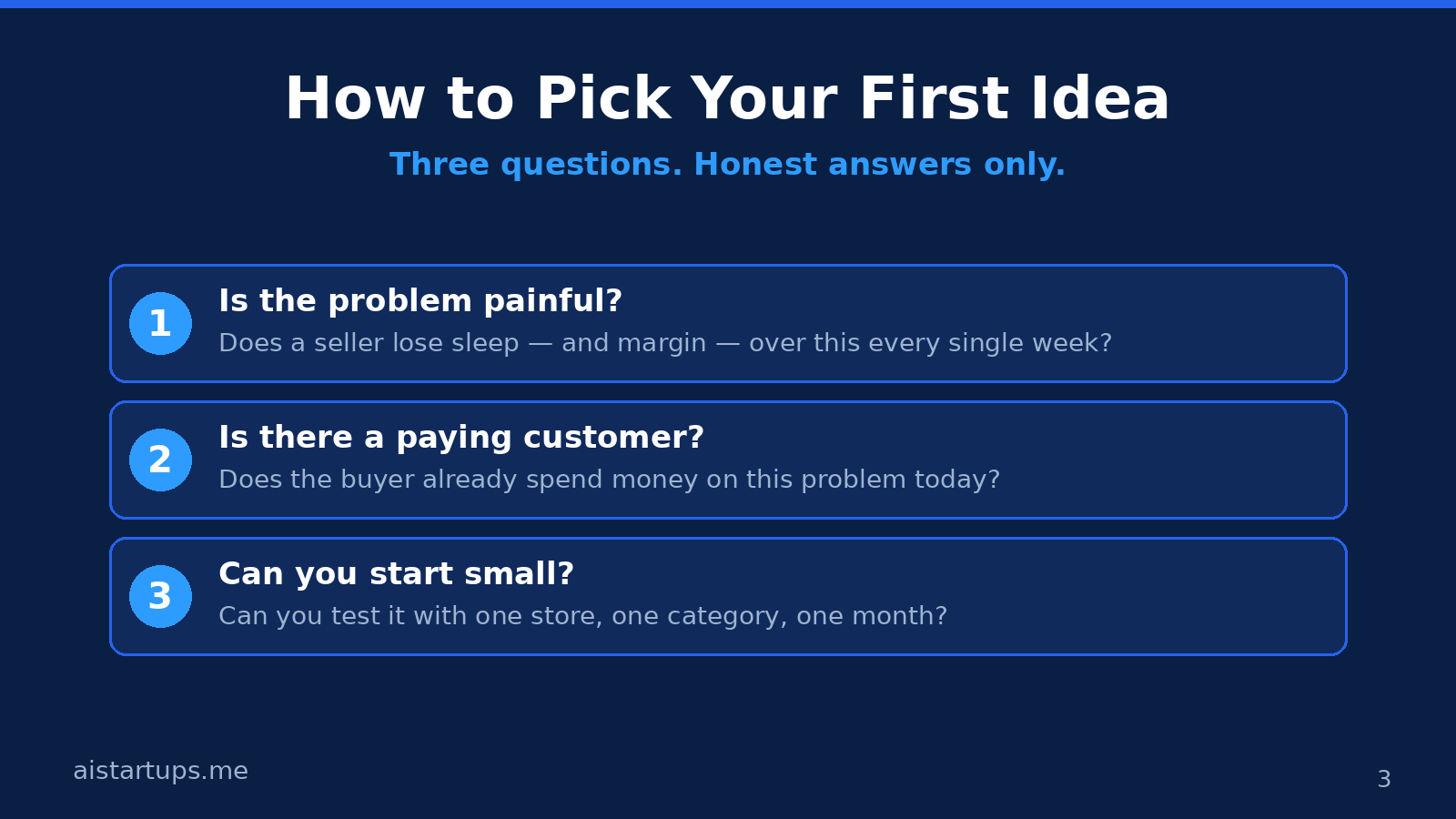
First, check your unfair advantage. If you’ve run a store, you already know which of these problems hurt most, and you know sellers who’d take your call. That’s worth more than any market-size chart. Second, check the data you can reach. A forecasting tool without sales history is a guess with a logo. A listing optimizer without marketplace access is a demo. Third, check the money path: can you name ten sellers who’d pay for this next month, by name? If you can’t, you don’t have a business yet — you have an idea. Go talk to ten sellers before you write a line of code.
Here’s a quick way to sort the list:
- Fastest to revenue: returns rescue, listing optimizer, review and UGC engine. Small scope, clear pain, sellers already pay for adjacent tools.
- Stickiest once it works: customer-service agent, subscription builder, demand forecasting. Harder to build, harder to rip out once it’s embedded.
- Biggest upside, highest risk: dynamic pricing and product photography. Huge value if you get it right, brutal trust and quality bars if you get it wrong.
And a word on the market numbers floating around this space. The AI in e-commerce market figures — about $11.21 billion in 2026, projected to roughly $74.93 billion by 2035 per Precedence Research — get quoted a lot, and they’re worth a skeptical look: they’re analyst projections, not counted revenue. Same with the traffic and sales claims from platforms — Shopify’s 8x AI traffic growth and Salesforce’s $67 billion Cyber Week figure are their own numbers, telling their own story. Use them as directional signals, not gospel. The real validation is always the same: a seller paying you, month after month, because your tool makes or saves them money. For a broader map of where AI startups are heading this year, the best AI website builders for startups in 2026 is a good companion read — most of these nine ideas need a solid home base, and the storefront is where it starts.
FAQ
What is the biggest AI opportunity for e-commerce sellers right now?
Post-purchase. Returns alone eat about 19.3% of online sales, per NRF and Happy Returns, and apparel runs 24–30%. Tools that rescue exchanges, automate order questions, and time replenishment offers attack costs and revenue that storefront tools can’t touch — and only 7% of retailers have scaled AI so far, per NVIDIA’s 2026 retail report, so the field is still open.
How much does it cost to start an AI e-commerce tool business?
Less than most people assume. A focused Shopify app or widget can be prototyped with API access, a language model, and a simple dashboard — the real cost is your time talking to sellers and validating the problem. Price against the value you create (rescued revenue, saved support hours, recovered inventory dollars) rather than your costs, and start with a small paid pilot instead of a free launch.
Do I need a technical background to build one of these ideas?
It helps, but it’s not the deciding factor. The deciding factor is access to sellers with the problem and the judgment to scope tightly. Many founders in this space pair up — one person who knows the seller’s world, one who builds — or they use no-code tools and APIs to validate before hiring a developer. Knowing the problem beats knowing the stack.
Which of these 9 ideas makes money fastest?
Returns rescue, listing optimization, and the review and UGC engine tend to monetize fastest, because the pain is obvious and sellers already pay for tools nearby. But “fastest” isn’t “best” — the customer-service agent and subscription builder are stickier long-term, and a sticky product with slower early revenue often wins over three years.
What are the biggest mistakes when building AI tools for sellers?
Three, and I’ve seen all of them. First, building a general tool instead of a focused one — “AI for e-commerce” is not a product. Second, letting the AI guess instead of grounding it in real order, inventory, or review data — invented delivery dates and wrong product images destroy trust fast. Third, hiding your misses — if your forecasts or recommendations are wrong sometimes, show it and improve. Sellers forgive honest tools. They don’t forgive confident ones that lie.
The Bottom Line
The storefront got all the attention for a decade. It’s time to look past it. The sellers winning in 2026 aren’t the ones with the prettiest homepage — they’re the ones whose returns turn into exchanges, whose prices move with the market, whose shelves are stocked with what people actually want, and whose customers hear back in minutes instead of days.
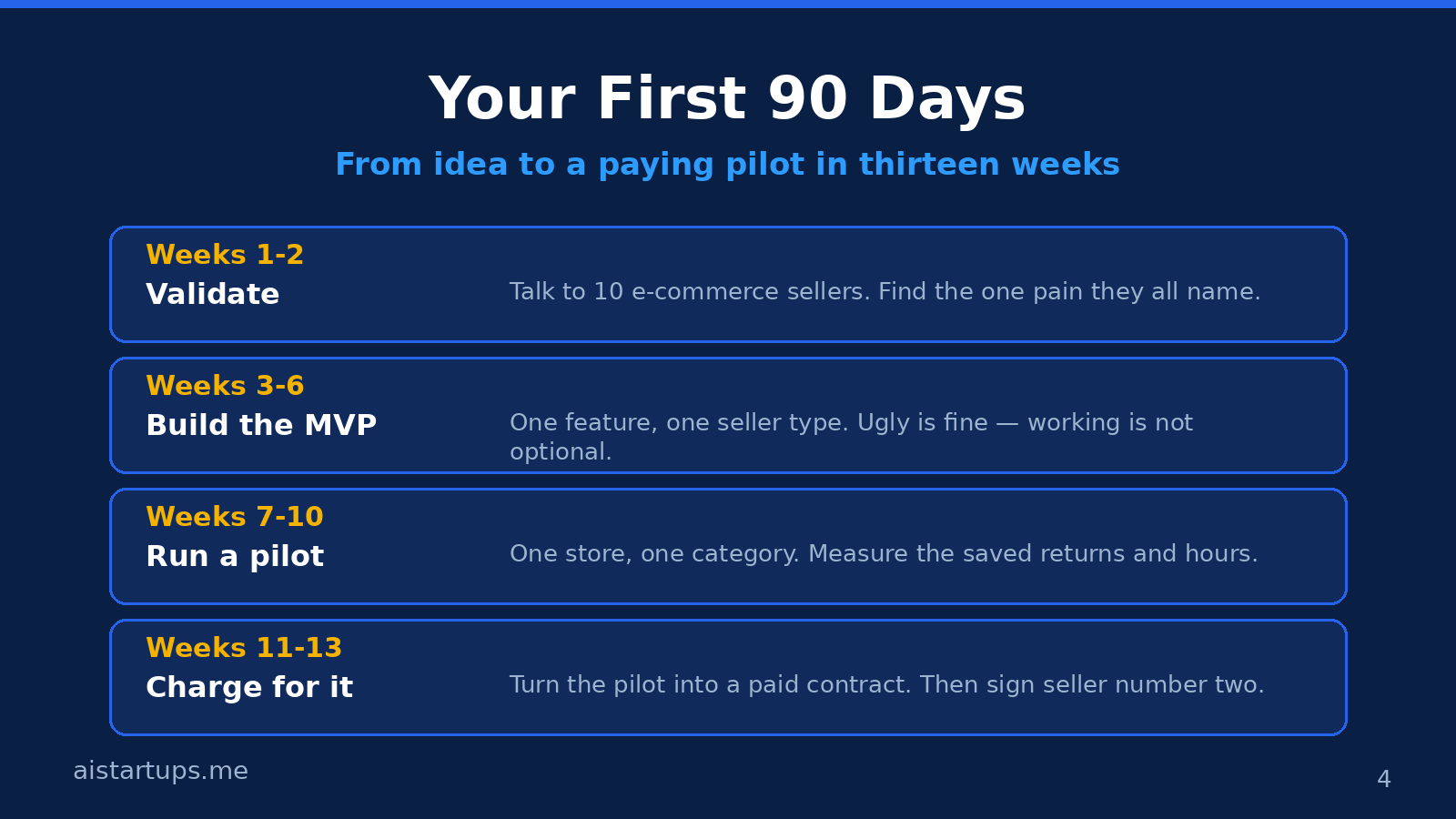
Pick one idea from this list. Not the one that sounds coolest — the one where you know ten sellers by name who feel the pain. Talk to them this week. Build the smallest version that solves it. Charge for it. Then make it better, one seller at a time.
That’s how this market gets built — not by one giant platform, but by a hundred small tools that each fix one leak. And there’s room for yours. The gap between the 89% of retailers who’ve adopted AI and the 7% who’ve scaled it is where the next wave of sellers’ tools will come from. Go build one of them.
Sources worth a look if you want to verify the numbers yourself: the AI in e-commerce market report from Emergen Research, a solid roundup of AI in e-commerce statistics from Resourcera, the average e-commerce return rate research from 3PL Insider, the return rate by industry breakdown from Omniconvert, agentic commerce statistics from Axis Intelligence, and the Klaviyo pricing overview from Retailpresso.