


Real talk: the best AI clients aren’t tech companies. They’re the dentist down the street, the HVAC contractor with three vans, and the med spa that misses half its calls because the receptionist is doing three jobs at once.
Here’s the thing — these business owners don’t care about foundation models or agent frameworks. They care about one thing: the phone getting answered and the calendar getting filled. And right now, they’re buying AI services from whoever shows up with a working demo.
I spent the last few weeks digging through 2026 pricing data from agencies actually selling these services, plus fresh small-business research. The numbers surprised me. So let’s talk about the 11 AI services you can realistically sell to local businesses this month — with real prices, the tools to deliver them, and how to land your first clients.
Why Local Businesses Are the Perfect AI Clients Right Now
First, the demand side, because this is what makes the whole thing work. Homebase just released its 2026 Main Street AI Gap Report, based on 750 small business owners, and the numbers are kind of wild:
- 74% of small businesses now use AI — up from 64% a year ago. That’s a 10-point jump in twelve months.
- 89% of adopters say it’s paying off, and 87% say it saves them time.
- Businesses using AI for scheduling and payroll save an average of $4,100 a year.
- And here’s the kicker: 62% of the ones NOT using AI want to. Their top worries aren’t the technology — they’re data privacy (38%) and mistakes (31%). That’s a trust gap, not a tech gap. A real human showing up and setting things up properly closes it instantly.
America alone has 33.2 million small and medium businesses, making up nearly half the US economy. The vast majority are in that under-$500k-revenue band where adoption is lowest (54%) — which means the least-served businesses are also the most numerous.
Meanwhile, on the delivery side, BrightLocal’s data shows only 44% of Google Business Profiles are fully optimized and 38% of small businesses have no strategy for collecting Google reviews. So even the basics are undone. There’s real money sitting on the table for anyone willing to do the work.
Honestly? This is the best setup a solo founder or tiny agency could ask for: massive demand, low competition, and buyers who value done-for-you over DIY.
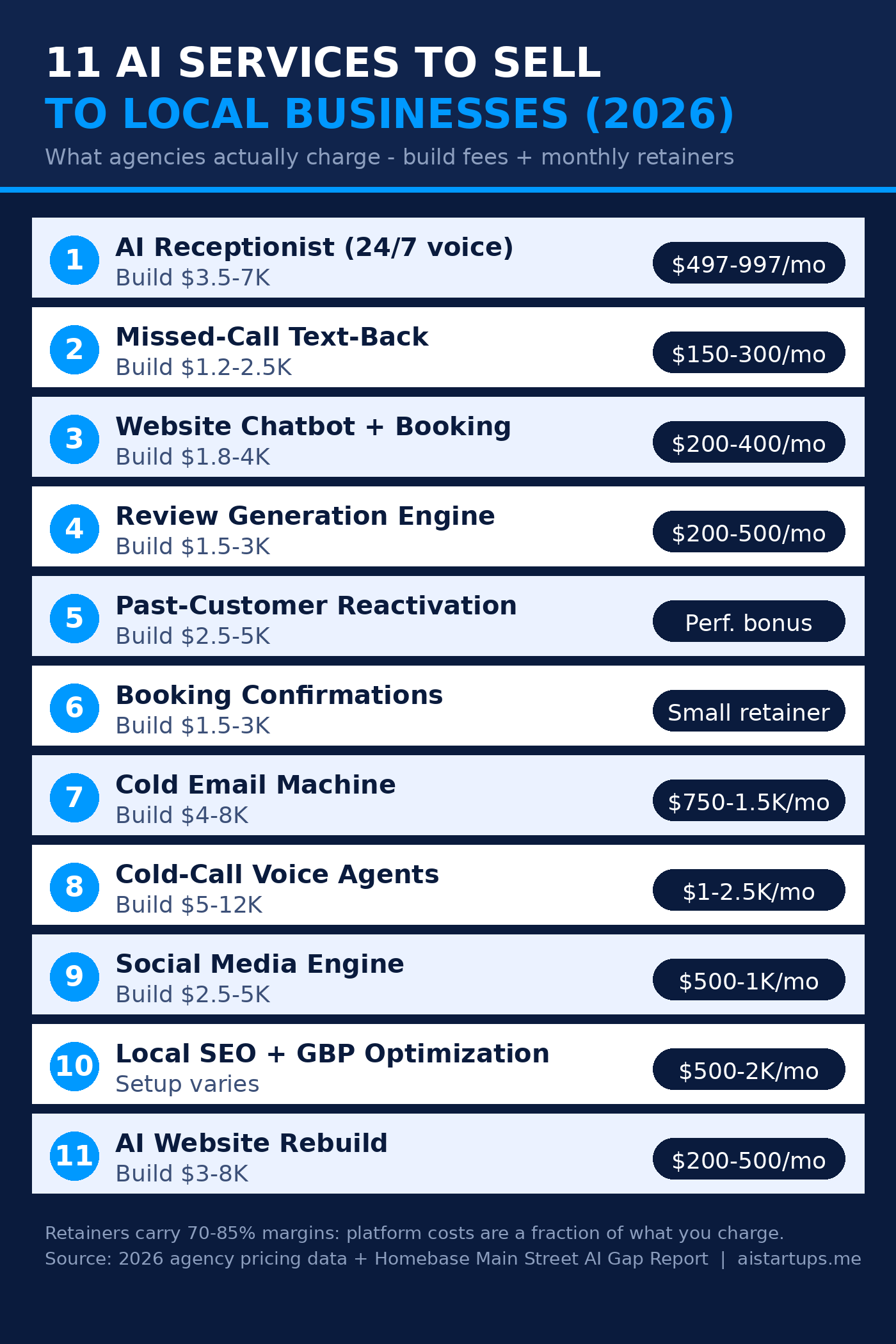
The 11 Services (With Real Prices)
These prices come from 2026 agency pricing data — including a widely-shared breakdown of 20 AI services businesses actually pay for — plus what AI agencies report closing in practice. Treat them as market bands, not gospel. Your local market and your demo skills will move you up or down inside them.
1. AI Receptionist (Voice, 24/7)
The crown jewel. An AI voice agent that answers the business’s phone around the clock, books appointments straight into their calendar, answers FAQs, and texts the owner a summary after every call.
Why it sells: every business with a phone is already losing money to missed calls — and the numbers make the pitch easy. Standalone AI receptionist tools now start around $29–$79 a month (Dialzara is ~$29, Rosie’s from $49, Goodcall from $79), while a human receptionist costs $3,000–$4,500 a month. The mid-tier sweet spot most small businesses actually land on is $150–$250 a month — which books appointments, writes leads into the CRM, and routes urgent calls to the owner’s cell.
As the agency, you charge a $3,500–$7,000 build fee to set it up on their business, then a $497–$997 monthly retainer for the phone minutes, monitoring, and tweaks. Agency trainers consistently say this is the service to start with: fastest to build, easiest to sell, and every contractor, clinic, and salon on Earth needs it.
Your costs? Voice platforms like ElevenLabs ($0.08–$0.12/min all-in), Retell AI (~$0.07/min plus add-ons), or Vapi ($0.05/min platform fee) mean a typical client’s monthly minutes cost you tens of dollars while you collect hundreds. That’s the margin this whole game is built on.
2. Missed-Call Text-Back
Simpler cousin of the AI receptionist: when the business misses a call, the caller automatically gets a text within 60 seconds — “Sorry we missed you! How can we help?” — and the conversation continues by SMS, ideally ending in a booked appointment.
Why it sells: most businesses miss 20–30% of calls, and callers rarely leave voicemail — they call the next listing. This one automation recovers leads the business already paid to generate. It’s the cheapest service on this list to build and one of the fastest to demo.
Charge $1,200–$2,500 to set up, plus a small monthly retainer ($150–$300) for the messaging costs and maintenance. Pitch it as a standalone quick win, then upsell the full AI receptionist once they trust you.
3. Website Chatbot With Booking
A chat widget on the business’s website that answers questions from their actual business info (hours, pricing, services) and books appointments directly into their calendar — no “call us during business hours” dead ends.
Why it sells: most local business websites are digital brochures. Visitors with questions at 10 PM bounce. A chatbot trained on the business’s FAQs turns those after-hours visitors into booked jobs. It also filters out tire-kickers by asking qualifying questions before offering a slot.
Charge $1,800–$4,000 to build, with a $200–$400 monthly retainer. Build it with any modern chatbot builder or a custom setup on the business’s site; the real work is writing the FAQ knowledge base, which takes an afternoon of interviewing the owner.
4. Google Review Generation Engine
An automated system that texts or emails customers right after a job is done, asking for a Google review — with a smart filter that routes happy customers to the review page and unhappy ones to the owner privately first.
Why it sells: reviews are the #1 ranking factor for local businesses that owners can actually control, and 38% of small businesses have no review strategy at all. U.S. consumers read an average of 10 reviews before trusting a local business. A steady review flow can move a business from page two to the local map pack — and map pack visibility is worth real revenue.
Charge $1,500–$3,000 to set up, plus $200–$500 a month to manage it. This pairs beautifully with the local SEO service below as a package deal.
5. Past-Customer Reactivation Campaigns
The business’s old customer list is a goldmine nobody touches. You build automated SMS and email sequences that re-engage past customers: “It’s been 6 months since your last cleaning — here’s 15% off this month,” appointment reminders for recurring services, seasonal offers.
Why it sells: it’s the easiest ROI story in marketing. These customers already trust the business; they just forgot about it. Agencies report this as one of the highest-margin services because the tech is simple (CRM + automation) but the revenue impact is immediate and visible.
Charge $2,500–$5,000 to build the sequences and import the list, with a monthly retainer tied to campaigns sent. Many agencies take a performance kicker here — a small percentage of reactivated revenue — because the numbers are so easy to track.
6. Booking Confirmations and No-Show Rescue
Automated appointment confirmations (24 hours and 2 hours before), easy reschedule links, and a follow-up sequence when someone no-shows — because no-shows are pure lost revenue.
Why it sells: for dentists, clinics, salons, and contractors, a single no-show can cost $100–$300. If your system prevents even five no-shows a month, it pays for itself many times over. Homebase’s CEO John Waldmann put it plainly:
“When local businesses have a scheduling mix-up or a payroll error, their time and money go out the door. Both are real costs to small businesses.”
Charge $1,500–$3,000 to set up. It plugs into whatever booking system they already use, so the sales pitch is “we connect to what you have — nothing to learn.”
7. Cold Email Machine (for B2B Local Services)
For local B2B services — commercial cleaning, IT support, business insurance, commercial landscaping — you build an AI-powered outbound system: lead lists, personalized first lines written by AI, automated follow-up sequences, and reply handling.
Why it sells: local B2B businesses live and die by outreach, and most do it manually or not at all. An automated outbound engine that books 3–5 qualified meetings a month is worth thousands to a business that closes even one new contract.
Charge $4,000–$8,000 to build, with a $750–$1,500 monthly retainer for list building and campaign management. This is higher-ticket work, but the clients (B2B) have bigger budgets and think in terms of contract value, not hourly cost.
8. Cold-Call Voice Agents
The outbound version of the AI receptionist: an AI voice agent that calls lists of prospects — following up on old quotes, reactivating cold leads, or qualifying inbound leads within minutes of them arriving.
Why it sells: speed-to-lead is brutal math. Businesses that contact a lead within 5 minutes convert dramatically better than those that wait an hour. An AI agent that calls every new lead instantly, 24/7, is something no human team can match at a sane cost.
Charge $5,000–$12,000 to build — the priciest service on this list — with retainers in the $1,000–$2,500 range. Start with simpler services and graduate to this one once you have case studies. One note: keep it compliant with robocall regulations (TCPA in the US) and stick to warm lists and existing customers unless the business has proper consent. This matters — get it wrong and it’s not a marketing problem, it’s a legal one.
9. Social Media Content Engine
A system that turns the business’s raw material — phone photos, short clips, job-site shots — into a month of social posts: captions written in the business’s voice, scheduled across Instagram, Facebook, and TikTok, with the owner approving everything in one weekly 15-minute session.
Why it sells: every local business owner knows they “should” post more. None of them do. The gap between knowing and doing is where your retainer lives. You’re not selling content — you’re selling the feeling of being active and visible without spending Sunday nights writing captions.
Charge $2,500–$5,000 to set up the system and brand voice, then $500–$1,000 a month for ongoing content. Pro tip: bundle the video version (repurposing one long clip into a week of Shorts/Reels) as the premium tier.
10. Local SEO and Google Business Profile Optimization
The unsexy one that prints money. You optimize the business’s Google Business Profile (categories, photos, services, posts), build local citations, fix their NAP consistency, and set up that review engine from service #4.
Why it sells: remember — only 44% of Google Business Profiles are fully optimized. That means more than half of local competitors are leaving the single highest-ROI marketing channel in local business half-empty. And clients already budget for this: Ahrefs’ survey of 439 SEO providers puts the average local SEO retainer at $1,557 a month, with 42% of providers charging $250–$1,000. You can price a “local visibility package” at $750–$1,500 a month and sit right in the market’s sweet spot.
This is also the perfect AI-assisted service: AI does the keyword research, writes the location pages, drafts the GBP posts — you do the strategy and quality control. The margins are excellent once the system is built.
11. AI-Powered Website Rebuild
Most local business websites are five years old, slow, and built for desktop. You rebuild them as modern, fast, mobile-first sites with an AI chat assistant and online booking baked in from day one.
Why it sells: the website is the foundation every other service on this list plugs into. A chatbot needs somewhere to live. Booking needs a fast page. SEO needs clean structure. Sell the rebuild as the “home base” and every other service becomes a natural add-on.
Charge $3,000–$8,000 for the build depending on size, with a $200–$500 monthly care plan. And if the design and development side feels like more than you want to take on solo, partner with specialists — that’s the kind of work a web development studio like AISquadX does for clients every day, from design and build through AI integration, so you can focus on selling and servicing the account.
How to Price and Package It
Don’t sell these as one-off projects if you can help it. The agencies making real money use a simple structure:
- Build fee + monthly retainer. The build fee covers setup ($1,200 on the low end, up to $12,000 for voice agents). The retainer covers your platform costs plus monitoring — typically $200 to $2,500 a month depending on the service. Retainers are where the business gets good: 70–85% margins are common because your actual costs (API minutes, messaging fees) are a fraction of what you charge.
- Start with a low-friction entry point. Trainers who sell voice AI full-time report that $10k setup fees are losing to $497–$997 monthly retainers, because clients hate big upfront commitments. A free 7-day trial or a one-service pilot (“let’s just do missed-call text-back for a month”) closes far more deals than a $8,000 proposal.
- Bundle for stickiness. Receptionist + review engine + reactivation is a $1,500–$2,500/month package that becomes load-bearing for the business within 90 days. Single services get cancelled; ecosystems don’t.
- Charge for outcomes, not hours. “I’ll answer your phones for $600 a month” beats “I’ll spend 20 hours configuring Retell.” Nobody cares about your hours. They care about the 30 calls you caught.
On the cost side, know what it actually costs to start an AI business before you price — most of these services run on $50–$200 a month in tooling per client, so price from value, not from cost.
Landing Your First 3 Clients (This Month)
Forget cold DMs at scale. For local services, the playbook is embarrassingly simple:
1. Build one demo for a specific niche. Pick dentists, HVAC, or med spas. Build a working AI receptionist demo that answers like their business. Not a slide deck — a phone number they can call. When a plumber calls a number and an AI books a fake appointment flawlessly, the sale is 80% done. This is the same principle behind validating the idea before you build anything: the demo IS the validation.
2. Walk in, don’t email. Local business owners are drowning in spam. Walk into 20 businesses in a week with your phone in hand. “Hey, I built something for businesses like yours — can I show you in 60 seconds?” Five minutes, live demo, leave a one-page sheet. Ten conversations a day beats a hundred cold emails.
3. Offer the pilot, not the project. “Let me run missed-call text-back for your shop for 30 days. $500 setup, $200 a month, cancel anytime. If it doesn’t pay for itself, I’ll refund the setup.” That offer is nearly impossible to refuse, and once you’re inside the business, upselling the receptionist and review engine is natural.
Your first client is the hardest. Your third client onward comes from referrals — local business owners all know each other, and “my phones finally get answered” is the kind of thing they talk about at the chamber of commerce.
If you’re still mapping out the model, these solo AI agent business ideas pair well with everything above — and the broader list of profitable AI startup ideas for 2026 is worth a skim if you want to think bigger than services.
FAQ
Do I need to know how to code to sell AI services to local businesses?
No. Most of these services are built on no-code and low-code platforms — voice agents on Retell, Vapi, or ElevenLabs; chatbots on off-the-shelf builders; automations on Make or Zapier; websites on modern builders or with a dev partner. What you actually need is the ability to understand a business’s workflow, configure tools to match it, and show up when something breaks. The selling matters more than the stacking.
How much can you realistically make selling AI services to local businesses?
Do the math on retainers: 10 clients at an average of $800 a month is $8,000 in monthly recurring revenue, with platform costs typically under $2,000. Solo operators commonly report hitting $10k–$30k MRR within 6–12 months. The ceiling depends on how fast you can sell and fulfill — most stall on sales, not delivery.
Which AI service should I sell first?
Missed-call text-back or the AI receptionist. They’re the fastest to build, the easiest to demo (every owner has felt the pain of a missed call), and they create the trust that lets you upsell everything else. Avoid starting with cold-call voice agents — highest price, highest complexity, and compliance risk you don’t want while you’re learning.
How do I handle it when the AI makes a mistake with a client’s customer?
Honestly — it will happen, so plan for it. Every service you sell should have guardrails: confidence thresholds that hand off to a human, call summaries the owner reviews, and clear escalation paths. This is also your competitive moat against DIY: 31% of non-adopters cite fear of mistakes as their top concern, per the Homebase report. The agency that shows up, monitors, and fixes things is exactly what they’re paying for.
Isn’t this market getting saturated with AI agencies?
In online guru circles, sure — everyone talks about it. On actual Main Streets, almost nobody is walking into the dentist’s office with a working demo. The 33.2 million small businesses in the US alone, with adoption lowest among the smallest ones, mean the addressable market dwarfs the number of people seriously selling. The window is open, but it won’t stay this open forever — which is why the topic is what you can sell this month.
The Bottom Line
Local businesses don’t need another app to learn. They need their phones answered, their reviews flowing, their old customers coming back, and their calendars full. AI can do all of that now, cheaply and reliably — but somebody has to set it up, watch it, and answer for it when it glitches. That somebody can be you.
Pick one service. Build one demo for one niche. Walk into twenty businesses this week. The agencies already doing this aren’t smarter than you — they just started. So start.